How to Evaluate and Manage Investment Risk

How to Evaluate and Manage Investment Risk
Understanding Risks with Stock Market Investing
In the fluctuating universe of investing, the term 'investment risk' stands as a core component that dictates the behaviors and strategies of investors. Investment risk refers to the concept of losing an investment partially or entirely because of numerous market variables.
This premise is particularly influential for those navigating the unpredictable and dynamic landscape of the stock market. The omnipresence of risk in the investing sphere accentuates the importance of risk analysis.
Understanding the answer to questions like "how much Tesla or Microsoft do I own?" is a critical step in being able to apply the practice of risk management in your own investing.
This essential process holds the key to fortifying an investor's financial armor, enabling them to make informed decisions that could either minimize potential losses or maximize profits.
Understanding the importance of risk analysis unfolds untapped potential for investors. When investing in the volatile stock market, risk analysis plays a crucial role as a preventative measure. It allows investors to gain a comprehensive understanding of the potential risk factors associated with their investments, thereby enabling them to create a robust plan to protect their capital.
Risk analysis is not just about evading or managing risks—it also assists in identifying profitable risk-taking opportunities. In essence, risk analysis enhances the predictability of the often-erratic behavior of the stock market, empowering investors with knowledge and forecasting abilities that could spell the difference between financial growth and loss.
Several risk analysis techniques have been fashioned to guide investors throughout their financial journey. These often require a blend of mathematical analysis, market research, and intuition honed by experience. One commonly used technique is diversification.
Renowned investor Warren Buffett famously stated, "do not put all eggs in one basket". The crux of diversification is distributing investments over diverse assets to reduce vulnerability to any single asset's performance. This reduces the impact of a single poor performing investment on the overall portfolio.
Another notable technique is value investing, which involves investing in stocks that appear to be trading for less than their intrinsic or book value. While inherently long-term, this strategy offers a level of protection against investment risk as it involves only investment in fundamentally strong stocks that are undervalued by the market.
Implementing the use of stop-loss orders is another strategy. This allows investors to limit their loss by setting a predetermined level to sell a stock if it falls below a certain price. It works as a safety valve against unforeseen market downfalls.
Successfully managing investment risk is a delicate balance of understanding, anticipation, and strategic planning. It is a continuous process where investors must remain vigilant and proactively reassess their investment portfolios in light of market developments. Understanding risk and incorporating strategies to manage it into investing frameworks is not just about amplifying chances of returns—it's a critical tool for survival in the dynamic world of stock market investing. As such, it has truly become an art unto itself.
What is Investment Risk?
Risk, in the broadest sense, can be described as the chance or likelihood of a negative or adverse event occurring, often assessed by considering potential outcomes in relation to the likelihood of them happening. The concept transcends various spheres from everyday life decisions to high-stake financial scenarios. Therefore, it is essential to comprehend the nuances of the term 'risk' from a more comprehensive perspective and delve into the multi-faceted types that exist.
Focusing on the financial realm, particularly in the stock market, risk is a fundamental part of investing. Investment risk is the certainty or probability of losses relative to the expected return on an investment. It revolves around the concept of uncertainty, indicating that with investing comes the potential to generate a profit or experience a loss. Severe losses can be managed with proper portfolio management.
Let's unpack the different types of risk that an investor has to consider while making investment decisions. Firstly, the most common is market risk, wherein the potential loss may be caused by overall market factors. For instance, hikes in interest rates or political instability can lead to considerable market volatility.
Secondly, there is credit risk, particularly poignant while buying bonds, that is the risk that a company or government defaults on its bonds. Thirdly, investors must grapple with liquidity risk, meaning that specific potentially profitable investments might be challenging to sell quickly.
Furthermore, the innate operational risk comes into play, referring to an error within the operations of a company or fund. Reflecting on inflation risk, this is the chance that the cash flow from an investment might not be worth as much in the future because of changes in purchasing power due to inflation. Longevity risk needs to be considered by retirees, which is the risk of outliving one's assets.
Exploring an additional dimension, there exist currency risk, country risk, resurgence risk, and interest rate risk. All these contribute to the several types of risk out there. For example, interest rate risk impacts the value of bonds. As interest rates rise, bond prices tend to fall, and vice versa. Currency risk, on the other hand, concerns investments in foreign assets and is linked to changes in currency exchange rates.
Drilling down to a more manageable categorization, some take the 4 types of risk approach, often summarized as market, credit, liquidity, and operational risk. Each entity has its unique challenges, and therefore, it would be judicious to be acquainted with these risks thoroughly.
Whether risks you’re on the lookout for, being educated about them will ensure cautious and informed investment strategies, ultimately translating into intelligent financial decision-making. Despite this, bear in mind that investing is not a risk-free undertaking. The key lies in balancing the level of possible reward against the potential risk, adding a thoughtful risk management plan to the investing repertoire.
Different Types of Investment Risk
Investment risk management is an essential factor for any investor. It is an inevitable part of the investment process where successful strategies are designed to identify, assess, and understand investment risk. In the realm of investing, risks come in different types and differing levels of impact, all of which deserve careful consideration.
Investment risks are often categorized into systematic and unsystematic types. Systematic risks, also known as market risk, are those that affect the entire economy or large sections of the market. Systematic risks cannot be eliminated through portfolio diversification and include the following:
- Interest Rate Risk
- Equity Risk
- Commodity Risk
- Currency Risk
Let's take a look at what each of these mean to you the investor in a bit more detail.
Interest Rate Risk
Interest rate risk pertains to changes in the cost of borrowing. An increase in interest rates reduces the value of fixed-income investments like bonds which inversely move with rates.
Equity Risk
Equity risk, meanwhile, is tied to changes in stock prices. Movements in global stock markets can significantly impact an investor’s portfolio.
Commodity Risk
Commodity risk refers to the risk that the price of the raw material may increase or decrease, which impacts businesses that rely on these commodities.
Currency Risk
Currency risk arises due to fluctuations in foreign currency exchange rates. A strong domestic currency may reduce the investment return in foreign stocks.
The level of risk associated with an investment is often directly proportional to its potential returns. A high investment risk may pose greater potential for loss, but it may also offer higher potential returns. Conversely, lower risk investments offer more predictable returns, but these tend to be modest. A treasury bond or an Exchange-Traded Fund (ETF) that mirrors a market index are examples of low-risk investments. These are typically recommended to conservative investors or those who cannot afford to lose their principal amount.
Different investment strategies such as aggressive and passive investing bear unique risks.
Aggressive investing is characterized by taking on large amounts of risk in hopes of achieving larger returns. Examples include putting copious amounts in high-growth stocks, or foreign markets.
Passive investing, on the other hand, involves building a well-diversified portfolio designed to mirror the performance of the market, typically through investing in index funds and ETFs. The risk here is not beating the market or not reaching investment goals if the market underperforms.
Understanding these types of investment risk allows for better decision-making. As the adage goes, "don't put all your eggs in one basket", diversification can help attenuate the effect of unpredictable market occurrences, thus, lessening the potential for losses.
Developing Your Risk Management
As an investor, better understanding your risks and how to manage them should be one of your primary investing goals.
Risk management is a comprehensive, structured approach focused on identifying, assessing, and strategizing to offset potential threats that may affect or impede the goals of a department, organization, or investment portfolio. In essence, it is a preventive measure adopted to minimize possible damages that could be inflicted by uncertain events.
An integral element of the investment sphere, risk management aims to predict and manage potential issues through various strategies, including, but not limited to, portfolio diversification and proper asset allocation. Portfolio diversification is a widely touted practice that advocates for investing in various asset types to spread risk.
This stratagem leverages the unlikely event of any significant financial calamity simultaneously affecting all classes of assets. For instance, a diversified portfolio might include a blend of equities, bonds, and commodities from diverse industries and geographies.
Asset allocation, on the other hand, is the strategy that systematically decides the proportion of funds to assign to specific asset classes. It considers factors such as investor's risk tolerance, financial goals, market trends, and investment horizon, among others. Consequently, a conservative investor would be advised to allocate a greater proportion of their portfolio towards safer assets like bonds, while a risk-tolerant investor might incline more towards equities.
How Magnifi and AI Can Help You Manage Risk
In the modern, tech-driven financial ecosystem, artificial intelligence plays a pivotal role in revolutionizing risk management processes. It dramatically augments portfolio management and the ability to identify investment opportunities, as well as the markets in general. AI-driven solutions meticulously scrutinize market trends, portfolio performance, and other relevant data to pinpoint vulnerabilities and threat signals that manual methods might overlook.
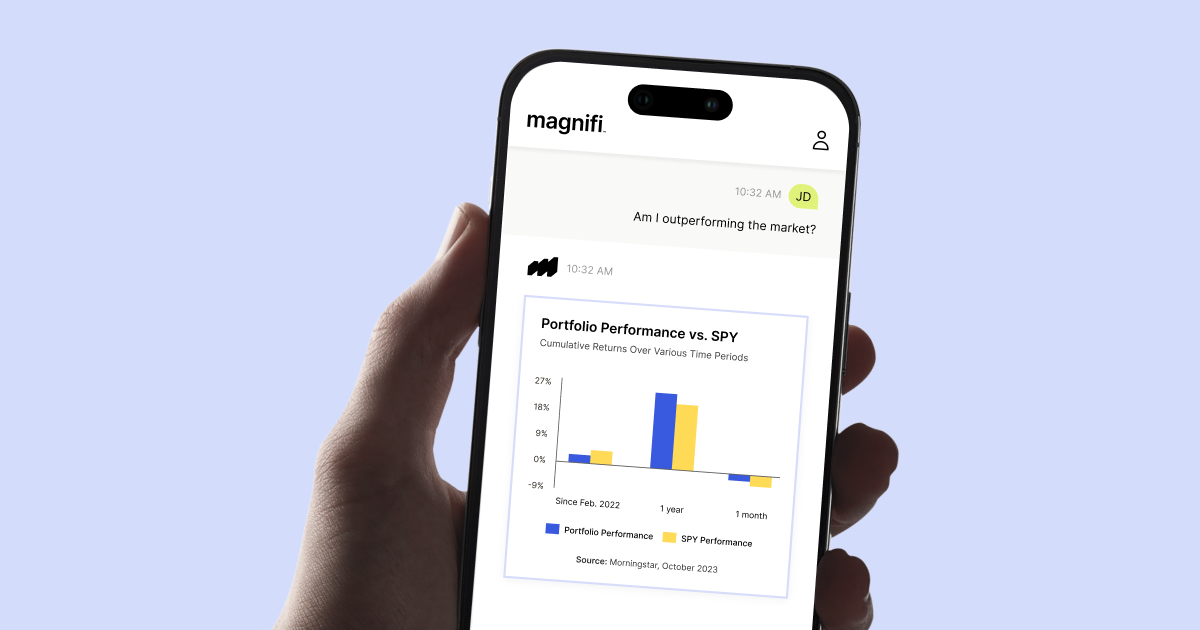
A sophisticated, AI-powered tool like Magnifi is a case in point. Magnifi offers multifaceted intelligence, unprecedented portfolio insight, and practical solutions to investment risk management. It analyzes vast data volumes with remarkable speed and accuracy, enabling investors to identify hidden risks that could potentially hamper their investment returns. The platform offers expansive coverage of global markets, currencies, and asset-classes, providing an all-encompassing risk assessment for informed decision-making.
To sum things up, risk management, particularly in the realm of financial investments, is a judicious blending of strategy, technology, and foresight. With the right balance of portfolio diversification, asset allocation, and AI-powered tools like Magnifi, investors can effectively navigate periods of financial uncertainty, helping to keep their portfolios healthy and their financial goals intact.
Try Magnifi Today
Click here to start investing with Magnifi.
Disclosures:
The information and data are as of November 20, 2023, unless otherwise noted and subject to change. This blog is sponsored by Magnifi.
This material is provided for informational purposes only and should not be construed as individualized investment advice or an offer or solicitation to buy or sell securities tailored to your needs. This information covers investment and market activity, industry, or sector trends, or other broad-based economic or market conditions and should not be construed as investment research or advice. Investors are urged to consult with their financial advisors before buying or selling any securities. Although certain information has been obtained from sources believed to be reliable, we do not guarantee its accuracy, completeness, or fairness. Past performance is no guarantee of future results. This content may not be reproduced or distributed to any person in whole or in part without the prior written consent of Magnifi. As a technology company, Magnifi provides access to tools and will be compensated for providing such access. Magnifi does not provide broker-dealer or custodial services.
Neither Asset Allocation nor Diversification guarantee a profit or protect against a loss in a declining market. They are methods used to help manage investment risk.
Fixed income securities are subject to increased loss of principal during periods of rising interest rates. Fixed income investments are subject to various other risks, including changes in credit quality, liquidity, prepayments, and other factors. REIT risks include changes in real estate values and property taxes, interest rates, cash flow of underlying real estate assets, supply and demand, and the management skill and creditworthiness of the issuer.
Investments in commodities may have greater volatility than investments in traditional securities, particularly if the instruments involve leverage. The value of commodity-linked derivative instruments may be affected by changes in overall market movements, commodity index volatility, changes in interest rates or factors affecting a particular industry or commodity, such as drought, floods, weather, livestock disease, embargoes, tariffs and international economic, political and regulatory developments. Use of leveraged commodity-linked derivatives creates an opportunity for increased return but, at the same time, creates the possibility for greater loss.
Mutual Funds and Exchange Traded Funds (ETF’s) are sold by prospectus. Please consider the investment objectives, risks, charges, and expenses carefully before investing. The prospectus, which contains this and other information about the investment company, can be obtained from the Fund Company or your financial professional. Be sure to read the prospectus carefully before deciding whether to invest.
Risk tolerance is an investor's general ability to withstand risk inherent in investing. The risk tolerance questionnaire is designed to determine your risk tolerance and is judged based on three factors: time horizon, long-term goals and expectations, and short-term risk attitudes. The adviser uses their own experience and subjective evaluation of your answers to help determine your risk tolerance.
There is no guarantee that the risk assessment questionnaire will accurately assess your tolerance to risk. In addition, although the advisor may have directly or indirectly used the results of this questionnaire to determine a suggested asset allocation, there is no guarantee that the asset mix appropriately reflects your ability to withstand investment risk.