How to Invest in India and Emerging Market Growth

How to Invest in India and Emerging Market Growth
Investing in the stock market has become a popular way for individuals to build and increase confidence in their financial future. The idea of investing for beginners can be both exciting and intimidating, but with a solid understanding of the fundamentals and a clear vision of one's investing goals, it is possible to navigate the world of stocks with confidence.
At its core, investing is about putting money into assets such as stocks, bonds, or real estate with the expectation that these investments will grow over time, providing returns that outpace inflation and help build wealth. The stock market, specifically, refers to a collection of exchanges where shares of publicly traded companies are bought and sold. By purchasing shares in these companies, investors become part-owners and can potentially benefit from any increase in the value of those shares.
To get started in investing in the stock market, one must first understand their own risk tolerance and investing goals. This involves determining how much money they are willing to invest and for how long they plan to remain invested. It is also essential to develop a diversified portfolio that includes a mix of asset types and industries to minimize risks associated with any single investment.
International Investing
For those looking for safe investments with high returns in India or elsewhere, it is crucial to research individual companies, industries, and regions thoroughly before making an investment decision. One enticing opportunity for investors seeking long-term growth potential is investing in India stocks. Given India's rapid economic development over recent years – driven by factors such as its young population demographic and technology advancements – the country has emerged as an attractive destination for investment. In addition to this growth potential, investing in Indian stocks allows investors access to various sectors within its burgeoning economy.
For instance, some may choose to focus on infrastructure development projects like roads or ports as they feel this sector will continue expanding along with India's overall economy. Others might target specific industries such as technology or pharmaceuticals due to their strong growth prospects globally.

Aside from direct investment in individual stocks, investors can also consider entering the Indian market through mutual funds and exchange-traded funds (ETFs). These investment vehicles pool the resources of multiple investors to purchase a diverse basket of securities, providing exposure to various sectors within the Indian economy. This approach allows for risk management through diversification and enables investors to benefit from the expertise of professional fund managers.
Investors should be mindful that while there are significant growth opportunities in India, there are also risks involved. Factors such as currency fluctuations, political instability, and regulatory changes can impact investment returns. Therefore, it is crucial for investors to conduct thorough due diligence when researching specific companies or industries before making investment decisions.
Investing in the stock market offers individuals an opportunity to build wealth over time by putting their money into assets that have the potential to grow in value. Investing for beginners may seem daunting initially, but with proper research and understanding of one's financial goals and risk tolerance, even novice investors can confidently enter this world. As part of a diversified portfolio, investing in India stocks presents an attractive option for those seeking long-term gains as they capitalize on the country's strong economic development trajectory.
By engaging in thorough research into companies and industries within India's burgeoning economy – or opting for professionally managed mutual funds or ETFs – investors can tap into a market rich with potential while mitigating associated risks effectively.
Investing in Emerging Markets 101
Investing in emerging markets offers investors a unique opportunity to participate in the growth of some of the world's fastest-growing economies. These markets often exhibit higher growth rates and potential for significant returns compared to developed economies, albeit with increased risks due to various factors, such as political instability and currency fluctuations.
An emerging market is a country or region that is experiencing rapid economic growth and industrialization but has not yet reached the level of maturity seen in developed countries. Some examples of countries often classified as emerging markets include Brazil, Russia, India, China (collectively known as the BRIC countries), Mexico, Indonesia, Turkey, and South Africa.
One key characteristic of these economies is that they typically have a large population base that provides abundant labor resources and robust consumer demand. India is considered an emerging market due to its vast population, rapid economic growth, and significant potential for further development. The Indian stock market today reflects the country's burgeoning economy and offers investors exposure to diverse sectors ranging from technology to manufacturing and consumer goods.
As per various economic forecasts by institutions like the International Monetary Fund (IMF) and World Bank, India's economy is poised for substantial growth over the next decade. Factors driving this optimism include strong domestic consumption patterns fueled by a growing middle class with increasing disposable income; infrastructure development initiatives undertaken by both public and private sectors; fast-paced technological advancements; sound macroeconomic policies; among others.
4 Ways to Invest Internationally
Investors based in the United States can also partake in India's economic progress through several avenues available for investing in emerging markets like India, such as selecting a fund from the India ETF list. Here are some ways on how to invest in Indian stock market from US:
- Exchange-Traded Funds (ETFs): ETFs are investment funds traded on stock exchanges that hold assets such as stocks or bonds within a specific index or sector. Several ETFs focus on Indian companies listed on major global exchanges like NYSE or Nasdaq or even ETFs tracking indices specific to the Indian stock market. These ETFs allow investors to gain exposure to Indian equities without directly trading on the local exchanges.
- American Depository Receipts (ADRs): ADRs represent shares of non-US companies listed on US stock exchanges, enabling access to foreign markets for American investors. Some of India's largest corporations, like Infosys and Tata Motors, have ADRs listed on the NYSE or Nasdaq, providing a convenient way to invest in these companies' growth.
- Mutual Funds: Several mutual funds focus on investing in emerging markets such as India. These funds typically hold a diversified portfolio of equities from various sectors within the Indian economy, offering risk mitigation through diversification and professional management.
- Direct Investment: For more experienced and savvy investors, opening an account with an international brokerage firm that provides access to the Indian stock market today is another option. This allows for direct investment in individual stocks traded on platforms like the National Stock Exchange (NSE) and Bombay Stock Exchange (BSE).
Investing in emerging markets such as India offers potential high returns but also comes with associated risks that must be carefully assessed before committing capital. The key lies in thorough research, understanding the unique opportunities and challenges presented by these markets, and adapting investment strategies accordingly.
How to Start Investing in India
A common question when beginning to invest in international equities is, "how?" How does one find the best investment in India right now? We'll explore the how here.
Investing in the stock market for beginners can be a tough task, but identifying investment opportunities abroad is even harder for beginners. However, during such economic times, a lot of investment alpha can be captured in a truly emerging market like India.
According to Reuters, the Indian economy is set to continue to grow at above 6% for at least the next two years. According to Statista, that growth is expected to continue at least until 2028.
Investing in Indian stocks has become increasingly popular among international investors, particularly those in the United States. The rapid economic growth and burgeoning middle class in India present attractive investment opportunities for individuals seeking diversification and exposure to emerging markets through careful portfolio analysis and management.
Tapping into Indian ETFs
However, navigating the Indian stock market can be complex due to differences in regulations, currency risks, and accessibility. This article will discuss various methods through which investors from the United States can invest in the Indian stock market, with a focus on Exchange Traded Funds (ETFs).
For beginners looking to invest money in India stocks, understanding how to access this market is crucial. One of the most accessible ways for U.S.-based investors to gain exposure to Indian equities is through ETFs that track Indian stocks or indices. ETFs are investment funds that trade on stock exchanges similar to individual stocks. They offer several benefits such as diversification, cost efficiency, and ease of trading.
A popular fund that grants investors access to investing in India is the Vanguard India ETF, the iShares MSCI India ETF (INDA). This is an example of a widely traded Indian ETF listed on U.S. stock exchanges. It seeks to track the performance of the MSCI India Index, which consists of large and mid-cap companies representing approximately 85% of the total market capitalization in India. Investing in this ETF enables investors an opportunity to participate in the growth story of some of India's largest companies.
Another option for investors considering where to invest money in India is iShares India 50 ETF (INDY). This fund aims at replicating the performance of Nifty 50 Index – comprising 50 largest publicly traded companies listed on National Stock Exchange (NSE) of India. The index represents a solid mix of sectors like financial services, information technology, energy, and healthcare.
Vanguard does not currently offer a dedicated India-focused ETF; however, they do provide exposure via their Emerging Markets Stock Index Fund (VWO), which includes allocations towards Indian equities.
In addition to broad-market-based ETFs, investors can also explore sector-specific and thematic ETFs that focus on particular industries or themes within the Indian market. For instance, VanEck Digital India ETF (DGIN) primarily invests in companies operating within the digital economy segments such as e-commerce, internet services, and digital payments. This fund provides targeted exposure to India's rapidly expanding digital landscape.
Similarly, the India Internet & Ecommerce ETF (INQQ) is designed to capture the growth potential of e-commerce, online entertainment, and other internet-based services in India. With its large consumer base and increasing adoption of smartphones and internet connectivity, this segment presents a unique investment opportunity for those looking to capitalize on emerging trends.
Investors seeking exposure to more niche areas of the Indian market might consider iShares MSCI India Small-Cap ETF (SMIN). This fund focuses on smaller companies within the Indian equity market that have higher growth potential but may also entail greater risk compared to their larger counterparts.
In conclusion, investing in Indian stocks can offer attractive opportunities for U.S.-based investors who want to diversify their portfolios by including exposure to one of the world's fastest-growing economies. Exchange Traded Funds (ETFs) provide a convenient and cost-effective way of accessing the Indian stock market while mitigating some risks associated with direct investments in foreign securities.
By carefully selecting from a variety of broad-market or sector-specific ETFs like iShares MSCI India ETF (INDA), iShares India 50 ETF (INDY), VanEck Digital India ETF (DGIN), or iShares MSCI India Small-Cap ETF (SMIN), investors can tailor their exposure according to their preferences and risk tolerance.
How Magnifi Can Help You Invest in India
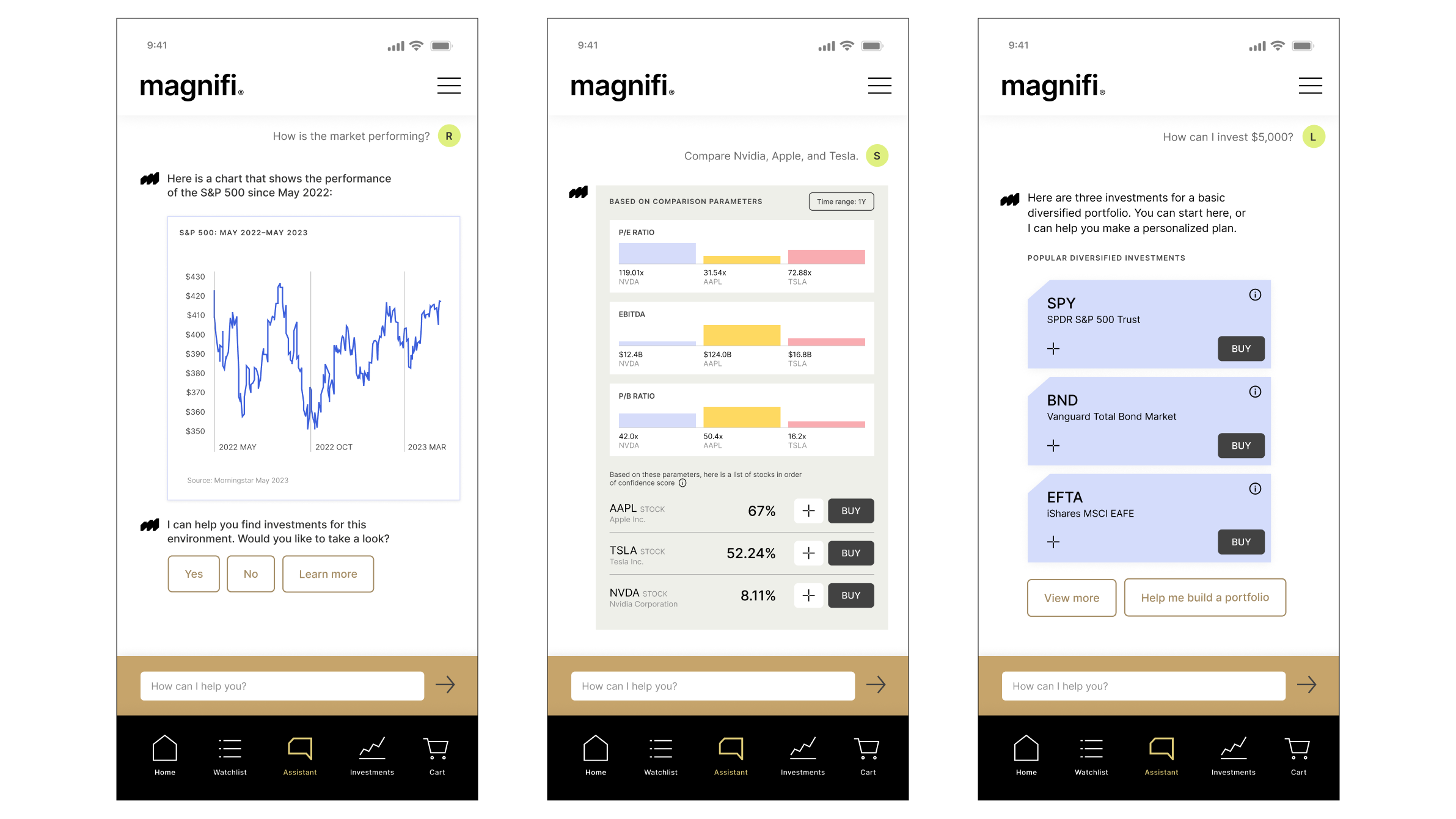
For those seeing the news of the growth going on in India, you may have come to the conclusion that now is the time to invest in India. Investing alongside the AI investing assistant, Magnifi, you can now find all the best stocks, mutual funds, and ETFs for investing in the Indian growth story unfolding right before our eyes.
Give It A Try Today
Ready to start investing? Click here to meet Magnifi today.
Disclosures:
The information and data are as of November 3, 2023, unless otherwise noted and subject to change. This blog is sponsored by Magnifi.
This material is provided for informational purposes only and should not be construed as individualized investment advice or an offer or solicitation to buy or sell securities tailored to your needs. This information covers investment and market activity, industry, or sector trends, or other broad-based economic or market conditions and should not be construed as investment research or advice. Investors are urged to consult with their financial advisors before buying or selling any securities. Although certain information has been obtained from sources believed to be reliable, we do not guarantee its accuracy, completeness, or fairness. Past performance is no guarantee of future results. This content may not be reproduced or distributed to any person in whole or in part without the prior written consent of Magnifi. As a technology company, Magnifi provides access to tools and will be compensated for providing such access. Magnifi does not provide broker-dealer or custodial services.
Indices are unmanaged and investors cannot invest directly in an index. Unless otherwise noted, performance of indices does not account for any fees, commissions or other expenses that would be incurred. Returns do not include reinvested dividends.
The Standard & Poor's 500 (S&P 500) Index is a free-float weighted index that tracks the 500 most widely held stocks on the NYSE or NASDAQ and is representative of the stock market in general. It is a market value weighted index with each stock's weight in the index proportionate to its market value.
Mutual Funds and Exchange Traded Funds (ETF’s) are sold by prospectus. Please consider the investment objectives, risks, charges, and expenses carefully before investing. The prospectus, which contains this and other information about the investment company, can be obtained from the Fund Company or your financial professional. Be sure to read the prospectus carefully before deciding whether to invest.
Active portfolio management, including market timing, can subject longer term investors to potentially higher fees and can have a negative effect on the long-term performance due to the transaction costs of the short-term trading. In addition, there may be potential tax consequences from these strategies. Active portfolio management and market timing may be unsuitable for some investors depending on their specific investment objectives and financial position. Active portfolio management does not guarantee a profit or protect against a loss in a declining market.
Neither Asset Allocation nor Diversification guarantee a profit or protect against a loss in a declining market. They are methods used to help manage investment risk.
Investments in emerging markets may be more volatile and less liquid than investing in developed markets and may involve exposure to economic structures that are generally less diverse and mature and to political systems which have less stability than those of more developed countries.