Am I Outperforming the S&P 500?

How You Can Beat the Stock Market
Am I outperforming the S&P 500?
This is a question that investors often ask themselves when they evaluate their portfolio's performance. To answer this query, it is essential to understand what it means to outperform the S&P 500 and how one can assess whether their investments are indeed beating the stock market.
Outperforming the S&P 500 refers to generating better returns than those offered by the Standard & Poor's 500 Index, an index that comprises 500 leading US-based companies across various industries. These companies represent a significant portion of the stock market's total value, making the S&P 500 an essential performance benchmark for investors. Therefore, if your investment portfolio generates higher returns than this index, you have successfully "beaten the market."
To determine whether you are outperforming the S&P 500 or not, you need first to calculate your portfolio's annualized return. The Magnifi investing app, along with others like it, track your portfolio's performance, so you don't have to worry about this kind of calculation.
Once you know your portfolio's return, you can then compare this figure with the corresponding annualized return of the S&P 500 over an identical period. If your portfolio's return exceeds that of the index, you have managed to outpace it.
With Magnifi's AI-powered portfolio analysis acting as your investing assistant, you can even ask it to compare your portfolio's returns with that of the S&P 500 through an index fund like SPDR S&P 500 ETF Trust (SPY) to see how you stack up.

However, beating the market consistently is no easy feat. A popular saying in finance is that "past performance does not guarantee future results," which emphasizes how challenging it can be to maintain success in a constantly evolving financial landscape.
As per multiple studies, what percentage of investors beat the market remains relatively low. For instance, research suggests that only about 10% of retail investors manage to beat their respective benchmarks.
More specifically, roughly under 25% of active managers successfully surpass their reference indexes. This statistic indicates that even professionals encounter difficulties in achieving consistent outperformance relative to these critical financial goals and milestones.
The concept of "can individual investors beat the market" has always been debatable among experts in finance and investment circles. However, several strategies and methods have been devised by successful individual investors who beat the market consistently.
One such approach is value investing, which involves identifying undervalued stocks and holding them for the long term. This method, popularized by legendary investor Warren Buffett, emphasizes the importance of meticulous research and patience in generating substantial gains.
Another potential strategy involves implementing technical analysis techniques to identify trends and patterns within financial markets. Successful technical analysts utilize this information to make informed investment decisions that can lead to market-beating returns.
Additionally, some investors adopt momentum trading strategies or focus on specific sectors or industries in search of opportunities that might outperform the market.
Determining whether your investment portfolio is outperforming the S&P 500 requires a comparison of your returns with those generated by the index over a similar time frame. While a significant percentage of retail investors and active managers struggle to consistently beat the market, various strategies have been employed by those who succeed in doing so.
Ultimately, it takes diligent research, patience, and an effective approach tailored to one's unique investment goals and risk tolerance level to secure consistent success within the complex realm of financial markets.
Bull and Bear Markets: What are the differences?
A bull market represents a period of time in which stock prices consistently rise, typically by at least 20%, demonstrating strong investor confidence and optimism about the future performance of the markets. This phenomenon can last for months or even years, as evidenced by the longest bull market in history that ran from March 2009 to August 2018.
During this time, investors are more inclined to buy stocks, believing that they will continue to increase in value.
Conversely, a bear market is characterized by a prolonged decline in stock prices, usually by at least 20%, reflecting negative investor sentiment and decreasing confidence in the markets. Bear markets can also persist for extended periods of time and can result in significant financial losses for investors who do not adapt their strategies accordingly.
Investors seeking to outperform the S&P 500 during any market condition have various methods at their disposal. One such method is identifying individual stocks outperforming the market. This entails conducting thorough research into specific companies or industries expected to experience significant growth in the foreseeable future.
By investing in these high-performing stocks early on, investors can potentially achieve returns greater than those of broader market indices such as the S&P 500.
Another approach to outpace S&P 500 returns involves focusing on value investing – a strategy pioneered by legendary investor Warren Buffett. Value investing seeks to identify undervalued stocks with strong fundamentals that are trading below their intrinsic value due to temporary circumstances or prevailing market sentiment. By purchasing these undervalued equities and holding onto them until they reach their true worth, investors can potentially realize substantial gains.
One example of stocks that have outperformed the S&P 500 over 10 years includes technology giants like Apple Inc. (AAPL), Amazon (AMZN), and Alphabet (GOOGL) (Google's parent company). These companies have experienced exponential growth driven by innovation and strong customer demand for their products and services.
During bull markets, investors may want to consider embracing a growth stock investment strategy. Growth stocks are those of companies with above-average revenue and earnings growth potential, which often translates to higher stock prices. By taking positions in these rapidly expanding firms, investors may be able to achieve returns that exceed the average bull market return.
Conversely, during bear markets, it is crucial for investors to adopt defensive strategies to preserve their portfolios from losses or even capitalize on the downward trend. One such strategy involves investing in dividend-paying stocks with stable cash flows and strong financial health. Dividend payments can provide a steady income stream during times of market volatility and instability.
Additionally, some investors choose to engage in short selling or utilize inverse exchange-traded funds (ETFs) during bear markets. These techniques allow investors to profit when stock prices fall by selling borrowed shares with the intention of repurchasing them at a lower price or investing in an instrument that inversely correlates with an index's performance.
To summarize, successful stock market investing entails adapting one's approach based on prevailing market conditions – whether bullish or bearish. Through careful research and diversification across various investment strategies, it is possible for investors to outperform the S&P 500 and potentially achieve significant long-term gains.
What stocks should I buy to outperform the S&P 500?
The stock market is an ever-evolving landscape, presenting numerous opportunities for investors to capitalize on the fluctuations in various sectors. While the S&P 500 remains a benchmark index for many investors, there are specific industries and stocks that have been outperforming it in recent times. A discerning investor should pay close attention to these shining stars and consider incorporating them into their portfolio.
One sector that has been consistently outperforming the S&P 500 is technology. Companies such as Apple (AAPL), Microsoft (MSFT), Amazon (AMZN), Alphabet (GOOGL), and Meta (META), formerly known as Facebook, have demonstrated impressive growth rates and profitability.
These businesses have thrived during economic downturns, making them prime candidates for those seeking "what companies do well in a recession." Furthermore, these tech giants were among the best performing stocks after the 2008 crash.
Another industry worth noting is healthcare. The ongoing pandemic has highlighted the significance of pharmaceutical companies like Pfizer (PFE) and Moderna (MRNA) or biotechnology firms such as Regeneron Pharmaceuticals (REGN) and Gilead Sciences (GILD). These companies have managed to maintain their strong financial positions amidst challenging market conditions.
When considering the top stocks to buy now, one must also examine pre-market trades as they offer valuable insights into potential market trends for the day ahead. Additionally, keeping an eye on the outperform stock list can provide essential information about which companies are expected to perform exceedingly well based on analyst ratings.
Understanding the meaning of outperforming stocks is vital for any investor seeking long-term gains. Simply put, it refers to stocks predicted to deliver higher returns than their benchmark index over a specified period. Conducting thorough portfolio analysis and monitoring the top active stocks today enables investors to make well-informed decisions when adjusting their portfolios accordingly.
Lastly, it's essential to remember that diversification plays a critical role in any sound investment strategy. Allocating resources among various industries and stocks can help manage risks and improve overall performance. For instance, investing in the best stocks to buy during a market crash can allow investors to maintain a balanced portfolio even during turbulent times.
Can Magnifi Help You Beat the Stock Market?
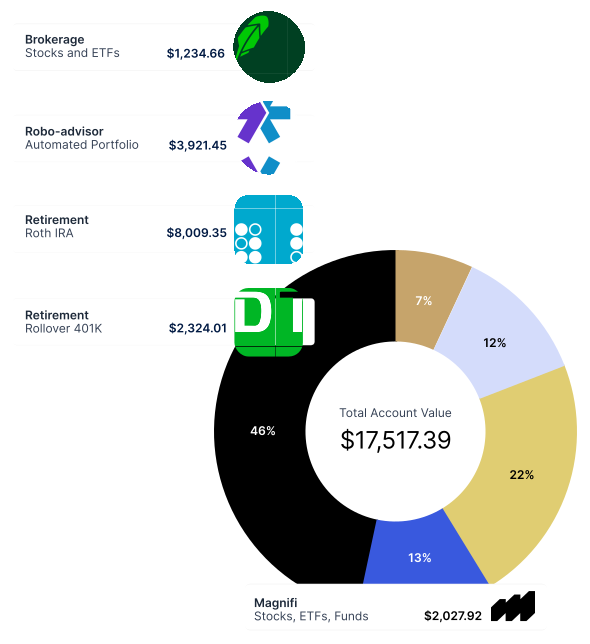
To stay updated with outperforming stocks today and monitor your investments effectively across multiple accounts, Magnifi offers an unparalleled solution through its innovative use of artificial intelligence (AI). This advanced platform provides investors with crucial data points on their entire portfolio performance while ensuring seamless integration between various investment accounts.
Financial news and analysis platforms like Yahoo Finance also serve as powerful tools for staying well-informed on market trends. However, with the constant influx of information, it's crucial to have an efficient system in place for processing data and tracking investments—a service that Magnifi excels at providing.
Staying vigilant on the sectors outperforming the S&P 500 and monitoring individual stock performance are crucial elements in successful investing. Capitalizing on solutions like Magnifi that utilize AI technology can help you stay ahead of the curve while maintaining a healthy and diversified portfolio.
An AI investing app provides a powerful tool for investors to evaluate mutual funds. It utilizes advanced algorithms and data analytics to assess not only the performance of different mutual funds but also their associated fees.
Magnifi also identifies the cheapest and most successful mutual funds on the market. In addition, over-allocating to one stock or sector in the stock market can hurt an overall portfolio. Magnifi mitigates this risk by highlighting whether a portfolio is heavily weighted towards a particular stock or sector.
Give It A Try Today
Ready to start investing? Click here to meet Magnifi today.
Disclosures:
The information and data are as of October 27, 2023, unless otherwise noted and subject to change. This blog is sponsored by Magnifi.
This material is provided for informational purposes only and should not be construed as individualized investment advice or an offer or solicitation to buy or sell securities tailored to your needs. This information covers investment and market activity, industry, or sector trends, or other broad-based economic or market conditions and should not be construed as investment research or advice. Investors are urged to consult with their financial advisors before buying or selling any securities. Although certain information has been obtained from sources believed to be reliable, we do not guarantee its accuracy, completeness, or fairness. Past performance is no guarantee of future results. This content may not be reproduced or distributed to any person in whole or in part without the prior written consent of Magnifi. As a technology company, Magnifi provides access to tools and will be compensated for providing such access. Magnifi does not provide broker-dealer or custodial services.
Indices are unmanaged and investors cannot invest directly in an index. Unless otherwise noted, performance of indices does not account for any fees, commissions or other expenses that would be incurred. Returns do not include reinvested dividends.
The Standard & Poor's 500 (S&P 500) Index is a free-float weighted index that tracks the 500 most widely held stocks on the NYSE or NASDAQ and is representative of the stock market in general. It is a market value weighted index with each stock's weight in the index proportionate to its market value.
Mutual Funds and Exchange Traded Funds (ETF’s) are sold by prospectus. Please consider the investment objectives, risks, charges, and expenses carefully before investing. The prospectus, which contains this and other information about the investment company, can be obtained from the Fund Company or your financial professional. Be sure to read the prospectus carefully before deciding whether to invest.
Active portfolio management, including market timing, can subject longer term investors to potentially higher fees and can have a negative effect on the long-term performance due to the transaction costs of the short-term trading. In addition, there may be potential tax consequences from these strategies. Active portfolio management and market timing may be unsuitable for some investors depending on their specific investment objectives and financial position. Active portfolio management does not guarantee a profit or protect against a loss in a declining market.
Neither Asset Allocation nor Diversification guarantee a profit or protect against a loss in a declining market. They are methods used to help manage investment risk.