Why Women Should Invest

Why Women Should Invest
What Makes Investing for Women Different?
For women investing, they face unique challenges every day that impact their personal finances. These challenges should be incorporated into the way that women approach saving and investing for their futures (1).
One of the most significant challenges faced by women is the pay gap. And while the pay gap is a topic that is frequently discussed, no appreciable gains have been made to close the gap in the past 20 years. According to the Pew Research Center, women earn only 82% of what men earn (2).
This means that for every dollar that a man earns, a woman is earning $0.18 less. For example, a man making $100,000 and a woman making $82,000 in the same city will have comparable expenses and living costs - say $60,000 per year for rent, food, transportation and taxes. After all of those expenses, the man has $40,000 and the woman only has $22,000 because of the pay disparity - this leaves them much less disposable income to invest (or enjoy!).

In addition to the challenge of pay disparity, women also live longer on average, and therefore need to plan for more years in retirement (or plan to work longer). The average life expectancy at birth for a man in the United States is 73.2 years and 79.1 for a woman (3).
So not only are women earning less, they are expected to live an additional 6 years beyond men and will need to plan ahead for those years. With assisted living facilities costing an average of $4,500 per month, that is an additional $324,000 that a woman will need to factor into her retirement plan for those six extra years (4)!
A third challenge is parenting. The United States is one of the only industrialized nations in the world that does not provide paid maternity leave. There is no federal law in the United States that requires companies to provide maternity leave. While some women are lucky enough to have this benefit provided by their company, many are forced to take unpaid leave during the first few months of their child’s life. An estimated 43% of women leave the workforce after becoming mothers - significantly impacting their financial independence and ability to save and invest for the future (5).
In light of these significant challenges, what should women do?
Investing Can Help Women Get Ahead
Through our surveys, we’ve found that women are less likely than men to invest in the stock market. In our Q4 2022 survey of 1,000 American adults, we found that while only 26% men said that they had never invested in the stock market, 41% women said that they had never invested.
Inflation is high right now. The long term average for inflation is around 3% (6), but current inflation is around 6% and even got as high as 7.87% in 2022 (7). This high inflation rate can eat away at your savings over time. If your dollars that you are putting into savings are earning less in interest than the current inflation rate, then those dollars are losing value. This mainly impacts your “purchasing power.” Because the prices of goods are increasing, you will need more dollars in the future to purchase the same amount of goods.
Example. You put $1,000 / year into your savings. If your savings is earning 2% on interest per year and inflation is 6% - in one year you will have $1,020, BUT the same goods you were purchasing for $1,000 now cost $1,060. You’ve essentially lost $40 in that year to inflation.
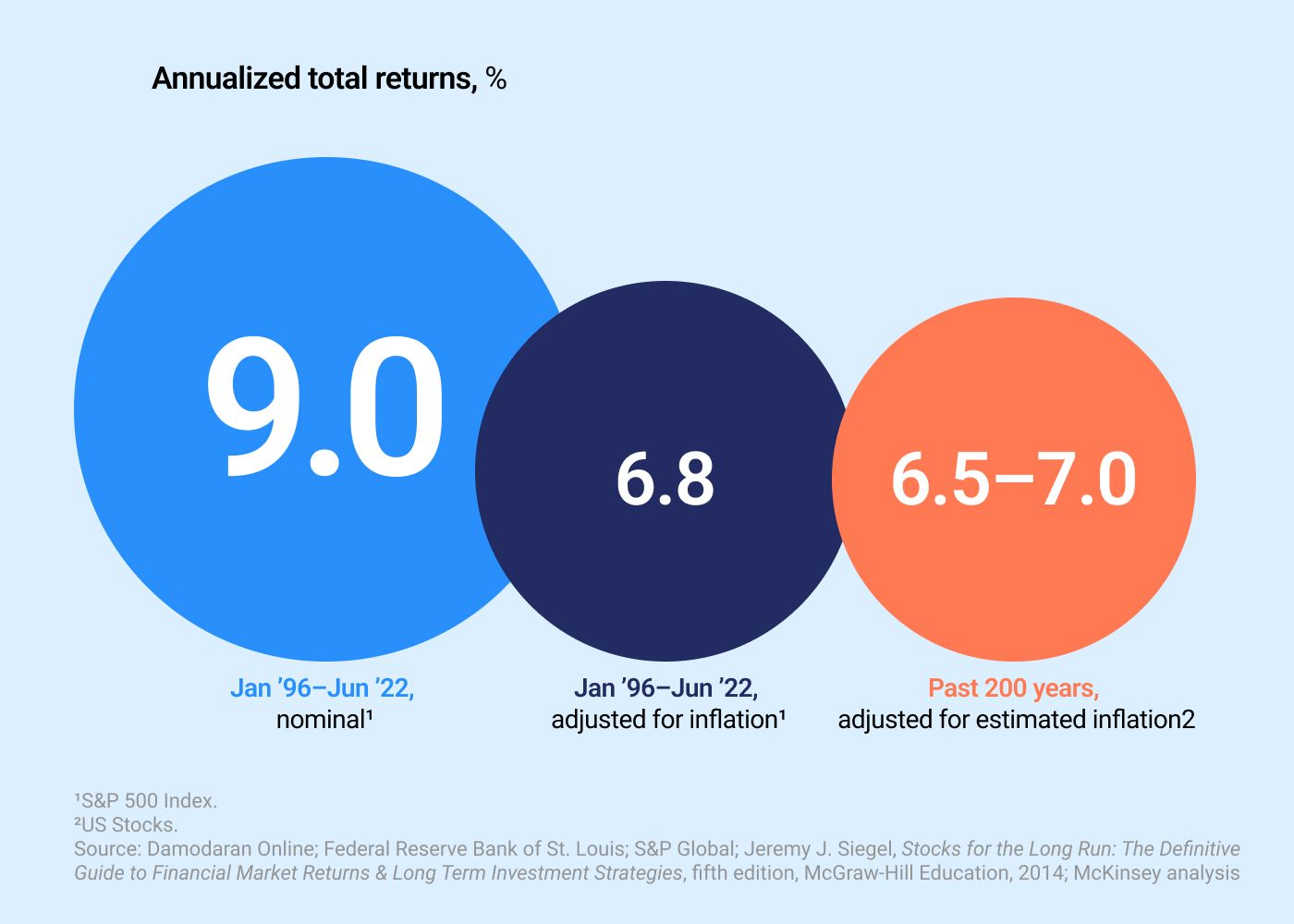
In contrast, the stock market has returned 6.5 - 7% per year, adjusting for inflation. By investing you can help your money to grow. There are also risks to investing which you should be aware of. If you’re brand new to investing and looking for a place to learn more, check our our recent article “Normal Person Explains the Stock Market.”
What can a woman investor do to get ahead of these challenges and start saving for the future?
How to Start Investing for Beginners, Like So Many Women?
In our recent study, Magnifi found that 80% of people (including 77% of women) agreed that personalized investing advice would lead to better financial outcomes. What works for someone else won’t necessarily work for you when it comes to investing. It’s a good idea to have an investing plan that’s tailored to your specific goals and outcomes. As you’re starting to invest, you should identify your goals. This article can help you choose your goals and stay on target to reach them.
Time is your greatest advantage when investing - compound interest helps your money to grow over time and greater time in the market helps you even out losses. Most online brokerages have low- to no-minimums; zero commissions on trades and access to fractional shares (this is when you buy less than one share of a stock. For example, some stocks can trade for $1,000 or more, so rather than buy a whole share, you could spend $100 and buy 10% of one share, or whatever you can afford at the time). You can easily get started with an investment as small as $5 / month and grow from there.
Here are a few more tips as you start your portfolio:
- Stay diversified - Different types of securities in your portfolio (stocks, bonds, commodities, currencies) can help you stay more resilient when the economy changes. You want a portfolio that can withstand different market conditions.
- Consider ETFs - An ETF is a basket of securities that tracks a specific index - like the S&P 500. It trades on an exchange during open market hours, much like a stock, but has built in diversification by being investing in multiple securities at once. Unlike stocks, ETFs have management fees (called the expense ratio) - so be sure to check that the expense ratio is in line with similar ETFs.
Learning about investing and starting to invest are two great steps to take control over your personal finances and prepare for the future. There are investing apps that make it incredibly easy to get started and there are great resources that can help you every step along the way. While there are many challenges to being a woman, one of the greatest benefits is the support and community of other women - don’t be afraid to ask for help when you need it!
References:
- "Why Are Women Planning to Invest More in 2023?," March 8, 2023, magnifi.com, Link
- Aragão, Carolina, “Gender pay gap in U.S. hasn’t changed much in two decades” Pew Research Center, Link
- Arias, Elizabeth, et al. "Provisional Life Expectancy Estimates for 2021," The Centers for Disease Control, Link
- Hoyt, Jeff, “How Much Does Assisted Living Cost in the U.S.?” 22 March 2023, Seniorliving.org
- “About the Mom Project,” The Mom Project, Link
- Per Magnifi “The long-term average for inflation in the United States has been around 3% per year over the past century.”
- “US Inflation Rate (I:USIR),” YCharts, accessed 3/22/2023, Link
Disclosures:
Diversification does not guarantee a profit or protect against a loss in a declining market. It is a method used to help manage investment risk.
Mutual Funds and Exchange Traded Funds (ETF’s) are sold by prospectus. Please consider the investment objectives, risks, charges, and expenses carefully before investing. The prospectus, which contains this and other information about the investment company, can be obtained from the Fund Company or your financial professional. Be sure to read the prospectus carefully before deciding whether to invest.
Indices are unmanaged and investors cannot invest directly in an index. Unless otherwise noted, performance of indices does not account for any fees, commissions or other expenses that would be incurred. Returns do not include reinvested dividends. The Standard & Poor's 500 (S&P 500) Index is a free-float weighted index that tracks the 500 most widely held stocks on the NYSE or NASDAQ and is representative of the stock market in general. It is a market value weighted index with each stock's weight in the index proportionate to its market value.