Investment Shopping: Investing in E-Commerce Stocks

Investment Shopping: Investing in E-Commerce Stocks
How to Invest in E-Commerce
To better understand investing in the E-commerce industry, it is pivotal to comprehend its sheer magnitude and potential for the future of how we shop.
E-commerce, or electronic commerce, is the digital analogue of traditional brick and mortar retail trade - blending convenience and global accessibility. It refers to the purchase and sale of goods and services through the internet, making shopping a transcendent experience not confined to geographical boundaries.
When discussing E-commerce behemoths, Amazon (AMZN) is a monolithic entity that instantly springs into the collective consciousness. With a staggering global presence, Amazon has ascended to the status of a household name owing to its colossal product offering, ranging from books and consumer electronics to food items and clothing. Furthermore, Amazon's foray into web services and digital streaming has unequivocally augmented its E-commerce potency.
However, Amazon's ostentatious success is not without fierce competition. Shopify (SHOP), a cloud-based, multi-channel commerce platform designed for small and medium-sized businesses, has disrupted the conventional E-commerce landscape. Unlike Amazon, Shopify empowers businesses to establish their own online stores and sell products in a myriad of different ways, including physical and digital.
Turning our attention to the advantages of e-commerce, it offers consumers an unprecedented level of convenience, cost savings, and breadth of selection that traditional retail simply cannot compete with. From the comfort of their homes, consumers can browse through a vast array of options, compare prices, read customer reviews, and make an informed purchase decision.
For businesses, E-commerce provides access to a global marketplace, enhanced customer reach and visibility, reduced overhead costs, and data collection that facilitates targeted marketing strategies.
However, it is of paramount importance to acknowledge the downsides and disadvantages of E-commerce, especially for those investing in the industry. Factors such as:
- Lack of personal interaction,
- Potential for fraud, and
- Customers' need for sensory input (e.g., touching or trying on products) Pose palpable limitations. There are also challenges related to logistical concerns, protecting customer data, and tackling online competition.
E-commerce and business are inextricably entwined. In the contemporary technological zeitgeist, businesses can wield the power of E-commerce to optimize their operational efficiency, validate their market potential, assess customer behavior, streamline their supply chain, and fundamentally redefine their relationship with consumers.
The digital marketplace has burst open the doors for start-ups, small businesses and solopreneurs to actively partake and compete in the global business panorama. The economist Joseph Schumpeter’s concept of creative destruction—a process of constant flux where innovation replaced old industries—never seemed more cogent than in the context of E-commerce. By disrupting traditional business models, E-commerce is fostering a new era of entrepreneurship and customer-centric innovation.
Indeed, E-commerce isn't merely a trending buzzword. It is a paradigm-shifting movement, a crucible of innovation and economic growth that is reshaping the contours of global commerce. As businesses continually strive to harness the untapped potential of this evolving landscape, E-commerce remains at the epicenter of global digital strategy and entrepreneurship.
What is E-Commerce Investing?
E-commerce, often spelled as e-commerce, is fundamentally a type of business model that lets businesses and individuals buy and sell goods and services on an online platform. Through the pulsating veins of the internet, the world of commerce has been revitalized, getting a virtual incarnation in the form of E-commerce.
This dynamic business shift fosters a new environment where geographical boundaries recede into insignificance and time zones cease to pose a constraint. The transaction of buying or selling online is e-commerce in its rawest form.
The business of E-commerce operates by offering products or services on a digital platform, which could be a website, an application, or a social media channel. By leveraging the internet's power, E-commerce businesses can cater to a worldwide audience, an advantage that traditional retail businesses might lack. These businesses make money by selling their products or services online. They often procure goods at trade prices and then sell at retail prices, the difference, minus any operating costs, forms the profit margin.
The heart of E-commerce is convenience. Consumers can purchase products whenever they want, without having to step out of their homes. Such convenience, accompanied by a wide range of products and competitive prices, has significantly contributed to the explosive growth of the e-commerce industry.
In recent years, the surge in online shopping has grown exponentially, with more people opting for the comfort of buying online. From daily essentials to luxury items, the consumer's purchase range has stretched over the spectrum. This shift has dramatically impacted the business world by boosting E-commerce stocks. Investors are increasingly becoming attracted to these shares, and the E-commerce industry is becoming a hotbed for investment.
The allure of these stocks lies in the irresistible growth potential of the E-commerce sector. Traditional brick-and-mortar businesses have shifted to the online market space, and experts predict this trend to continue, fueling the growth of E-commerce. With the prospects of higher earnings and profits, investors find these stocks increasingly attractive. The influence of E-commerce on stock market trends is undeniable.
Moreover, tech-savvy millennials have been a dominant driving force behind the thriving of online commerce. Prioritizing convenience and speed, this demographic cadre has moved towards online shopping, impacting companies' economic dynamics in the process. The correlation of these driving shifts to the e-commerce industry and stock market has fostered the thriving environment for E-commerce stocks.
Being a spectator in this rapidly changing environment is no longer an option. The metamorphic transition from traditional retail shopping to E-commerce has redefined the business landscape. The promise of scalability and wider reach presents an unprecedented opportunity for businesses to expand and thrive in the digital arena while making E-commerce stocks a lucrative option for investors.
E-commerce meaning extends beyond a mere online buying or selling module. It represents the amalgamation of innovation, technology, and convenience, redefining the way businesses operate and consumers shop. As the narratives of age-old business models get rewritten, E-commerce is poised to become the spine of global retail. The flourishing business of E-commerce is not just about trading goods but shaping the path for future commerce and investments.
Investing in the E-commerce Business Model
In the digital age of business, e-commerce has become a firmly entrenched and growing aspect of the global economy. This digital trading of products or services using the internet is transforming the way people conduct business all over the globe, affecting everything from small local shops to international conglomerates.
Let's delve deeper into the quintessential instances of e-commerce businesses gaining momentum. Amazon, Alibaba, eBay, and Rakuten are some prominent e-commerce examples that have revolutionized the realm of online trading. Their innovative business models and strategic adaptations to consumer behavior have established new trends in the world of e-commerce.
Functioning as intermediaries, these online marketplaces provide platforms for small to large enterprises to sell their products and services to a global audience.

Approaching the holiday season, e-commerce trends undergo a dynamic shift influenced by changing consumer behaviors. An upward trajectory is traditionally noted in terms of consumer spending via online shopping. This surge stems from numerous major sale events like Black Friday, Cyber Monday, and Boxing Day sales.
One particularly intriguing phenomenon is the generally strong performance of e-commerce stocks during holidays. This pattern is interconnected to spikes in online buying prompted by Christmas shopping and year-end sales. This effect, sometimes called the "Santa Claus Rally," has fascinated investors and market pundits alike.
When discussing the term Santa Claus Rally in relation to the stock market, it refers to an end-of-year appreciation in stock prices typically occurring in the last week of December through the first two days in January. Its festive moniker stems from this seasonal increase in stock prices, like Santa Claus, coming just in time for the holidays.
While the Santa Claus Rally can affect stocks generally, for e-commerce companies this period often coincides with increased revenue from holiday sales. Consequently, investors often observe an accelerated growth in the value of their investments. But, while this seasonal trend can be profitable, it is essential for investors to comprehend that all stock market investments entail risk. Past performance does not guarantee future returns, and the Santa Claus Rally should be seen as a likely but not guaranteed trend.
In conclusion, the growth potential of e-commerce businesses cannot be understated. Embodying the power and reach of the internet, these online businesses are an epitome of a modern, advanced commercial era. As we approach the holiday season, businesses and investors alike can anticipate the forthcoming surge in e-commerce activities. However, understanding the risks associated with such ventures remains equally vital. Together, these elements create the dynamic, thriving ecosystem of e-commerce.
Magnifi Can Help You Invest in E-Commerce
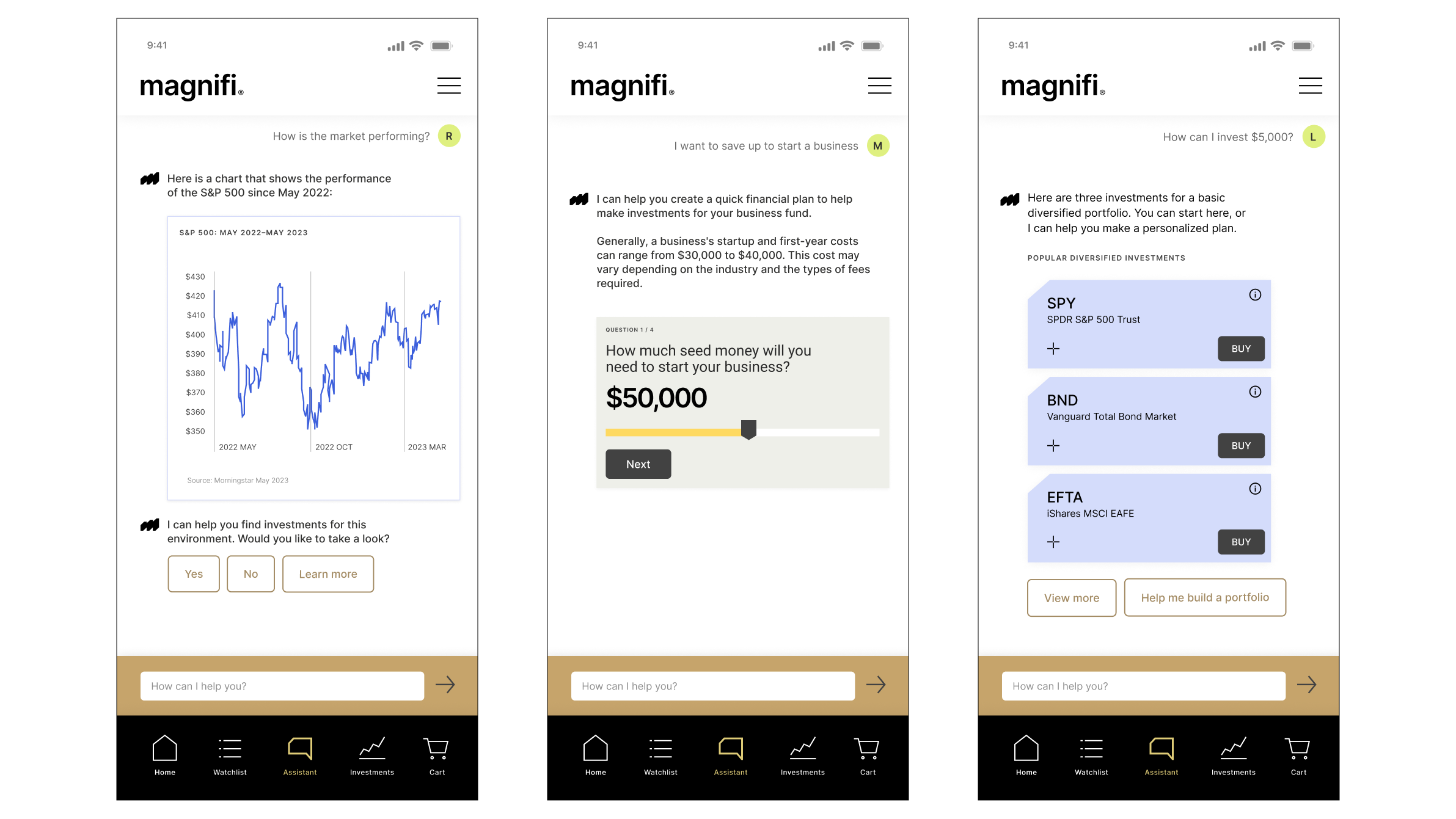
With the help of Magnifi, you can search, find, and invest in all the leading e-com names in the market with the tap of a few buttons. Not only that, you can ask your new AI investing assistant for guidance in what sectors to invest in and even if you have any current exposure to a stock you may be thinking about buying now.
Link your outside investment accounts to Magnifi today to take your portfolio analysis to the next level this year. Sign up and find out how AI-powered insights can help with your investing.
Try Magnifi Today Click here to start investing with Magnifi.
Disclosures: The information and data are as of November 17, 2023, unless otherwise noted and subject to change. This blog is sponsored by Magnifi.
This material is provided for informational purposes only and should not be construed as individualized investment advice or an offer or solicitation to buy or sell securities tailored to your needs. This information covers investment and market activity, industry, or sector trends, or other broad-based economic or market conditions and should not be construed as investment research or advice. Investors are urged to consult with their financial advisors before buying or selling any securities. Although certain information has been obtained from sources believed to be reliable, we do not guarantee its accuracy, completeness, or fairness. Past performance is no guarantee of future results. This content may not be reproduced or distributed to any person in whole or in part without the prior written consent of Magnifi. As a technology company, Magnifi provides access to tools and will be compensated for providing such access. Magnifi does not provide broker-dealer or custodial services.