4 Factors that Influence the Price of Oil
4 Factors that Influence the Price of Oil
The price of oil seems like it is constantly in flux, and largely, it’s because it is. So many factors play into what drives the price of oil higher or lower.
December 14th, the price of oil shot up nearly 4% to kick the day off. This rally came on the back of news of a weakening U.S. dollar, boosting commodity prices.
After Federal Reserve Chairman Jerome Powell’s unmistakable dovish Fed policy statement and projections caused a surge in the stock market, the U.S. dollar and interest rates began to slide. Since many of the commodity sales around the world are priced in dollars, this sent the prices of most commodities surging higher.
Perhaps above all the commodities in the bunch, oil can have a rather large influence on the overall market, and by default, investor portfolios, even if you aren’t investing in energy.
Measuring the Impact of Oil Prices
Knowing all this is useful, but with the technology that is available today, we ought to be able to see what a 4% rally oil can mean for our portfolio. Well, with portfolio analysis powered by AI, that day has finally arrived…
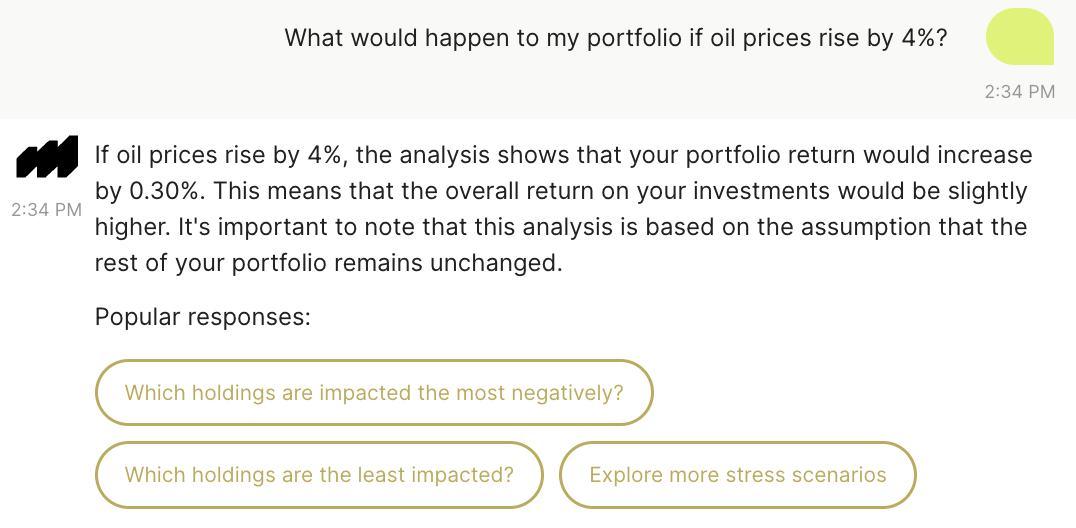
Fear that an unexpected jump or decline in oil prices is leaving you at risk? Using AI to analyze your portfolio, you can get a better idea of how fluctuating oil prices can affect the entirety of your investment portfolio.
To take it a step further, however, your AI investing assistant will also show you which investments are impacted the least and which are impacted the most. From there, you can decide the next course of action.
But in order to know what the best course of action would be, we need a better understanding of what can make the price of oil move. Let’s briefly explore some common occurrences that can cause the price of oil to move (or not move), depending on what’s going on around the world.

4 Common Factors that Can Move Oil Prices
1. Production Increases/Cuts
If you’re a seasoned investor, you know the four most influential letters in the energy industry, OPEC. Otherwise known as the “Organization of the Petroleum Exporting Countries,” OPEC is a permanent, intergovernmental Organization, created at the Baghdad Conference on September 10–14, 1960, by Iran, Iraq, Kuwait, Saudi Arabia and Venezuela.
This organization is often referred to as a cartel by many in the industry because they have such an overwhelming influence on the oil markets. They can collectively announce production cuts or increases based on what they’re seeing in the market and send prices of oil skyrocketing or crashing.
Since these countries account for so much of the world’s oil production, they carry this outsized sway in what happens to the price of oil. Something to be mindful of as you explore the idea of becoming an investor in oil or the energy sector.
2. The Value of the U.S. Dollar
Another common factor that comes into play regarding oil prices is the value of the dollar. As mentioned earlier in the article, because many commodity transactions around the world occur in the U.S. dollar, the price of the dollar directly influences the price of oil.
If the dollar is weaker, commodity prices see a bit of a relief. If the dollar is strong, it becomes more expensive to transact these commodities. Thus, causing demand (and prices) to drop.
Throughout 2023, there have been constant concerns over whether or not the Fed will continue to raise rates or cut them. With the December 13th FOMC meeting, the market was treated to dovish comments from the Fed for the first time in a long time.
Because of this, markets began to consider, due to the comments made by Fed Chair Jerome Powell, several rate cuts throughout 2024. These signs of quantitative easing relieved some of the upward momentum on the U.S. dollar, which the commodities market looked upon very favorably.
3. Supply Chain Constraints
As we all still remember, and are still dealing with, prices of just about everything go up when the supply chains are stuck in a stand still. The longer it takes and more expensive it becomes to ship goods around the world, the costlier things get.
This is no different for oil. After oil is pulled from the source and refined, it then needs to be transported to its end destination. If supply chains jam and that oil doesn’t get to where it needs to go, demand rises and supply dwindles, causing an inevitable increase in price.

4. War
One of the most unfortunate factors that lead to a jump in oil prices is war. At the onset of the Russian invasion on Ukraine, the oil and natural gas market experienced some disruption in the market, causing prices to spike.
Juxtapose that reaction to the reaction in the energy market as conflict in the Middle East continues where we have seen oil reach below $70/barrel.
War has a knack for causing fluctuations in a great many markets due to the uncertainty it creates. Will other countries join in on the conflict? When will it end? All questions the market would like to have answered in a perfect world.
However, war in these particular regions of the world is able to influence the energy markets due to the countries involved. Russia produces much of the energy for countries in the region through oil, natural gas, and coal. The same can be true for Ukraine.
War in the Middle East always presents some fragility to the energy market since this area of the world is responsible for so much of the output in the sector. War here always presents a potentially negative event for energy investors.
Try Magnifi
Now is the time to put this all together and see how you can apply this to your own investing. Don’t get caught off guard by unforeseen events like jumps in oil prices, let your AI investing assistant guide you along the way.
Invest with confidence that you’re prepared for whatever the market has to throw at you. Invest with Magnifi.
Click here to get started today...
Disclosures:
The information and data are as of December 14, 2023, unless otherwise noted and subject to change. This blog is sponsored by Magnifi.
This material is provided for informational purposes only and should not be construed as individualized investment advice or an offer or solicitation to buy or sell securities tailored to your needs. This information covers investment and market activity, industry, or sector trends, or other broad-based economic or market conditions and should not be construed as investment research or advice. Investors are urged to consult with their financial advisors before buying or selling any securities. Although certain information has been obtained from sources believed to be reliable, we do not guarantee its accuracy, completeness, or fairness. Past performance is no guarantee of future results. This content may not be reproduced or distributed to any person in whole or in part without the prior written consent of Magnifi. As a technology company, Magnifi provides access to tools and will be compensated for providing such access. Magnifi does not provide broker-dealer or custodial services.
Investments in commodities may have greater volatility than investments in traditional securities, particularly if the instruments involve leverage. The value of commodity-linked derivative instruments may be affected by changes in overall market movements, commodity index volatility, changes in interest rates or factors affecting a particular industry or commodity, such as drought, floods, weather, livestock disease, embargoes, tariffs, and international economic, political and regulatory developments. Use of leveraged commodity-linked derivatives creates an opportunity for increased return but, at the same time, creates the possibility for greater loss.