3 Uses for Impact Analysis in Your Investing

3 Uses for Impact Analysis in Your Investing
What is impact analysis?
Have you ever stopped to think about what would happen to your portfolio if the price of gold fell by 5%, the rate of the 10-Year Treasury increased by 1%, or if the equities market dropped by 40%?
Sure, it’s easy to say your portfolio will go up or down based on scenarios like the above, but what is the actual impact on your entire portfolio?
We can imagine what might happen, but as most of us know, how something plays out in our mind can vary wildly from what happens in reality. This is why running impact analysis on your portfolio is so important. It brings the possibilities to life, giving you actual data points, you can then use to adjust your portfolio’s allocation or strategy.

Impact analysis enables the investor to get a clear picture on what these hypothetical situations could do to your portfolio. If Treasury yields increase, it’s fair to assume that is a negative for the stock market.
Can you quantify what this will do to your positions? Given the current economic climate we find ourselves in, this is a pertinent question to ask… and receive an answer to.
In this article, we will explore some examples of how you can run impact investing analysis on your portfolio, so there is less lurking out that can catch you, or your money, by surprise.
3 Uses for Impact Analysis in Your Investing
1. What would the impact of gold's price falling 5% be on my portfolio?
For investors who have tied their ship to investing in precious metals such as gold or silver, knowing the price of each of these commodities is a must. Without knowing what the price of gold or silver is doing, you really don’t know how your investments are doing either.
Is the price of gold strong? Well, recently it has been, after reaching new all-time highs. However, as is often the case in a market as volatile as this, what goes up can certainly come back down.
So, what would the impact of a drop in gold's price mean for the rest of your portfolio? First, we need to understand the average relationship between gold and the rest of the market. Gold and equity have an inverse relationship. This means that when the gold price goes up, prices in the stock market will fall and vice versa.
Once this relationship is better understood, it really all depends on how much exposure to gold or other precious metals your investment portfolio has. If you are a big proponent of investing in gold, this one's for you.
Given all our specific portfolio’s construction, the impact of gold falling by 5% will vary differently, that’s why it’s so important to put your portfolio through such an analysis, so you know what the outcome might be, but more importantly, how you can manage this impact and optimize your portfolio.
2. What if the 10-Year Treasury yield rises 1%?
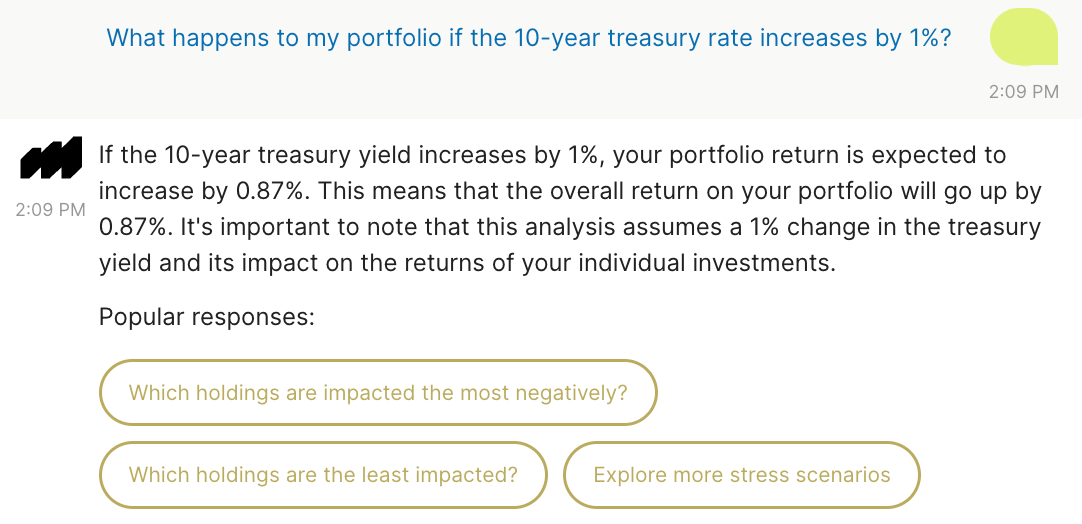
With Treasury yields acting up as they have through the year, it’s probably a good time to better understand how their increase (or decrease) will affect the market and your investing.
Soaring U.S. Treasury yields have boosted the appeal of bonds over stocks, threatening to weigh on equity performance over the long term.
Bond yields near historic lows bolstered the attractiveness of stocks over the past 15 years, when the U.S. Federal Reserve kept rates near zero to support the economy following the 2008 financial crisis.
This year’s climb in Treasury yields is changing that math just a bit, as government bonds offer income that is viewed as risk-free to investors who hold them to term. The yield on the benchmark 10-year U.S. Treasury - which moves inversely to bond prices - hit 5% a couple months ago, its highest level since 2007, in a climb fueled by hawkish Fed policy fears and fiscal worries.
What does this mean for your portfolio? Given the power of AI, investors can now run analysis to predict what the outcome of rising interest rates could mean for your money. This is the type of analysis that Magnifi was designed to help investors understand.
Ask your AI investing assistant to show you the hypothetical impact of rising Treasury yields and know just what your plan is if they begin to creep up once again.
3. If oil goes up by 30%, what will happen to my portfolio?
Back when prices were pushing hard toward +$90, investing in the oil industry had many investors trying to pile on to all the fun to catch a piece of the action…
Fast forward to now (December 2023), and oil prices have seen a near 30% retracement back below $70 per barrel. When prices were soaring, it was difficult to envision what would happen to your portfolio if oil had such a drop.
Suddenly, investors in oil or a stock tied directly to the price of oil, like Exxon Mobil (XOM), are treated to a position that is worth a lot less than just a couple months ago. Because you didn’t give much thought to the price of oil crashing, you still have your whole position intact, adversely affecting your portfolio’s value.
Human beings have a hard time imagining a thing can happen, especially when presented with evidence to the contrary, until it already has and it’s too late to act.
An excellent case for running another impact analysis, taking a hypothetical, and showing you the impact of if it became a reality.

Investing with Magnifi
These are just a few of the impact analysis tests you can run on your very own portfolio when you link your existing investing account to Magnifi or start fresh by building your very own Magnifi portfolio today.
With the power of AI at your fingertips, creating an action plan to achieve your financial goals has never been easier. Never miss a golden opportunity to grow your portfolio and avoid any risk that you may have overlooked on your path toward building confidence in your financial future.
Try Magnifi
Click here to start investing with Magnifi...
Disclosures:
The information and data are as of December 7, 2023, unless otherwise noted and subject to change. This blog is sponsored by Magnifi.
This material is provided for informational purposes only and should not be construed as individualized investment advice or an offer or solicitation to buy or sell securities tailored to your needs. This information covers investment and market activity, industry, or sector trends, or other broad-based economic or market conditions and should not be construed as investment research or advice. Investors are urged to consult with their financial advisors before buying or selling any securities. Although certain information has been obtained from sources believed to be reliable, we do not guarantee its accuracy, completeness, or fairness. Past performance is no guarantee of future results. This content may not be reproduced or distributed to any person in whole or in part without the prior written consent of Magnifi. As a technology company, Magnifi provides access to tools and will be compensated for providing such access. Magnifi does not provide broker-dealer or custodial services.
Asset Allocation does not guarantee a profit or protect against a loss in a declining market. It is a method used to help manage investment risk.
Investments in commodities may have greater volatility than investments in traditional securities, particularly if the instruments involve leverage. The value of commodity-linked derivative instruments may be affected by changes in overall market movements, commodity index volatility, changes in interest rates or factors affecting a particular industry or commodity, such as drought, floods, weather, livestock disease, embargoes, tariffs, and international economic, political and regulatory developments. Use of leveraged commodity-linked derivatives creates an opportunity for increased return but, at the same time, creates the possibility for greater loss.
Fixed income securities are subject to increased loss of principal during periods of rising interest rates. Fixed income investments are subject to various other risks, including changes in credit quality, liquidity, prepayments, and other factors. REIT risks include changes in real estate values and property taxes, interest rates, cash flow of underlying real estate assets, supply and demand, and the management skill and creditworthiness of the issuer.