Invest with a Robo Advisor, AI Assistant or a Financial Advisor?

Invest with a Robo Advisor, AI Assistant or a Financial Advisor?
How Can Artificial Intelligence (AI) Support Your Investing Strategy?
Retail investors—aka individual investors taking part in the stock market—have a lot of options for how to go about investing. Outside of a 401(k) or other employer-led fund, the main methods are: do-it-yourself (DIY), robo advisors, and financial advisors. As it turns out, artificial intelligence (AI) helps augment all of these strategies. But how?
We see AI in innovations like ChatGPT, a chatbot by OpenAI that answers questions and writes personalized essays, and platforms like Netflix, Spotify, and Amazon, which use AI to recommend personalized entertainment and products. In the same vein, AI’s place in the stock market births the empowered investor, helping to personalize their strategy, whatever path they choose.
Here’s how an AI assistant fits into what we call the retail investor triangle, and how retail investors can use AI to their advantage.
The Retail Investor Triangle
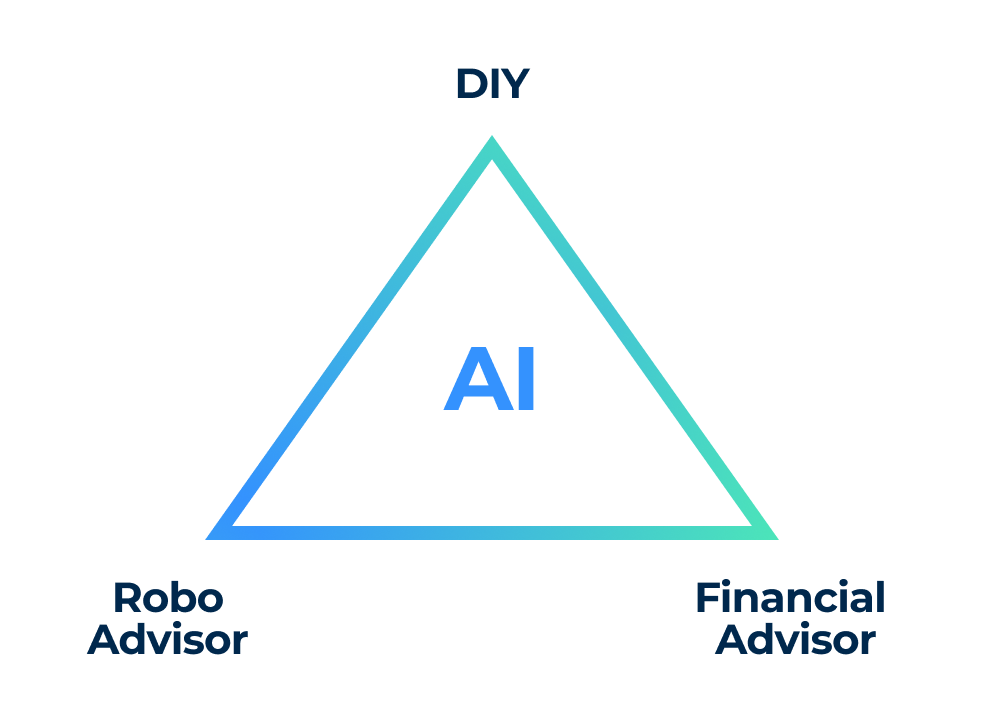
The retail investor triangle is made up of three points:
- DIY: Your investing strategy is totally self-directed with no professional guidance.
- Robo advisor: An algorithm chooses your investments for you based on your goals and risk tolerance (for example: low, medium, or high risk). You don’t have much control over your investments.
- Financial advisor: You pay a higher fee for a professional, getting a small part of their focus and energy.
In the middle of all three of these methods lies AI, an option that can enhance any avenue you choose. Let’s delve into how AI can level up each of these, what strategy may be best for you, and why.
The DIY investing strategy: Where an AI assistant comes in
What is a DIY investing strategy? A DIY investing strategy is exactly what it sounds like: a do-it-yourself method with no professional guidance.
According to a recent Magnifi study, 36% of Americans plan to invest on their own in 2023. This was the most popular option, well above working with a financial advisor (32%), robo advisor (4%), or not investing at all (28%). Needless to say, DIY investing is a popular path for people looking to build their financial future.
One of the key reasons DIY is so popular is the ability for investors to personalize their portfolios. For example, where one investor may want to invest for traditional retirement, another investor may have additional goals, like building passive income through dividend payouts for early retirement. DIY investing gives you the space to make these decisions for yourself. Personalized investing can look however you need it to look to make your ideal life come to fruition.
DIY + AI: AI assistance enables DIY investors to make educated investment decisions without having to give up control to a pre-selected portfolio or outsource to a pricey human advisor.
For example, Magnifi Personal is an AI assistant using natural language search so you can cut through financial jargon and find tailored recommendations for stocks and funds that may help you achieve your goals (1).
Users can ask all kinds of questions, like:
- “Am I on track to retire?”
- “How do I invest for dividends?”
- “How can I invest for social justice?”
With AI, you’re no longer investing alone—you have total control over your portfolio AND you can leverage data and intelligence to help you make smart investing moves.
Robo advisors and the role of AI
What is a robo advisor? A robo advisor is a wealth management service driven by an algorithm. Users typically have limited control over their investments, only customizing risk tolerance, goals, and initial investment (aka how much cash you put in, and how often).
Robo advisors + AI: AI is the backbone of a robo advisor. It drives the algorithm that, in turn, results in the investor’s returns. However, unlike the AI-backed DIY method, investors don’t actually have a direct say in what goes on in their robo advisor portfolio.
AI-driven robo advisors have strengths, including automated rebalancing (2), hands-off investing, and lower fees than a real-life financial advisor. However, they can’t hand-pick specific assets or create a comprehensive portfolio that takes into account all of your life goals. Where a robo advisor may falter, an AI-backed DIY strategy fills the gaps.
How financial advisors use AI to enhance their clients’ portfolio performance
What is a financial advisor? A financial advisor can advise anyone about their finances. One step up from the average financial advisor is the fiduciary financial advisor, who is legally bound to act in their clients’ best interests (rather than making financial decisions that earns them more commission, for example).
Financial advisors + AI: Financial advisors are real humans, but that doesn’t mean they don’t use technology to get their job done. Just like a DIY investor who leans on AI, a financial advisor may utilize their own AI assistant to streamline their work and improve outcomes for their clients.
Before entering an agreement with a financial advisor, investors should be aware of the fees associated with the service. These costs can eat into your stock market returns over time. However, if you encounter a large sum of money (such as winning the lottery or inheriting an estate), a human’s touch can be extraordinarily helpful.
For everyday investing, what if you cut out the middleman and used an AI investing assistant to address any blind spots yourself? This makes sense for investors who trust their ability to learn and want to maximize their cost basis (aka the purchase price of your investments, before any gains).
The 3 pillars of an empowered investor, enabled by AI
What is an empowered investor? To us, it’s someone with:
- Freedom of choice
- Access to information
- The ability to grow money
The reality is that AI is at the center of today’s retail investing environment. It’s always available and can generate personalization at scale.
Plus, AI doesn’t replace expertise. Rather, it helps everyday investors build expertise, making them their own financial advocate.
Just think: A beginner investor can use AI to ask, “What does a diversified retirement portfolio look like?” (3). Just a year later, that same investor may ask their AI assistant, “What are the top consumer staples funds with a low P/E ratio?”
Learn more about financial ratios here.
Whichever path you choose, AI can help open up doors many investors may otherwise have not been able to enter. If that’s not empowering, we don’t know what is.
References
- Mutual Funds and Exchange Traded Funds (ETF’s) are sold by prospectus. Please consider the investment objectives, risks, charges, and expenses carefully before investing. The prospectus, which contains this and other information about the investment company, can be obtained from the Fund Company or your financial professional. Be sure to read the prospectus carefully before deciding whether to invest.
- Rebalancing/Reallocating can entail transaction costs and tax consequences that should be considered when determining a rebalancing/reallocation strategy.
- Diversification does not guarantee a profit or protect against a loss in a declining market. It is a method used to help manage investment risk.