Investing in 3D Printing: How to Find Top 3D Printing Stocks
Investing in 3D Printing: How to Find Top 3D Printing Stocks
What is 3D printing?
3D printing, also called additive printing, has grown out of its hobby phase and matured into an integral part of industrial technology—with a wealth of growth opportunities for investors.
Investors note the potential impact of 3D printing across huge sectors like construction and healthcare, in stocks of tech giants like Microsoft and Autodesk, and in the proliferation of mutual funds and ETFs that focus on 3D printing technologies.
How did the world go from 3D-printing rough-around-the-edges prototypes to 3-D printing entire buildings? The pandemic highlighted weak links in the global supply chain, and lessons were learned. Fully one-quarter of U.S. manufacturers plan to upgrade their supply chains and they are prioritizing 3D printing as the key to this—over other options like 5G, artificial intelligence (AI), and robotics. The jump in businesses using 3D printing has already started, with the 3D printing market predicted to triple in size by 2026, reaching a value of $44.5 billion (1).
3D Printing 101
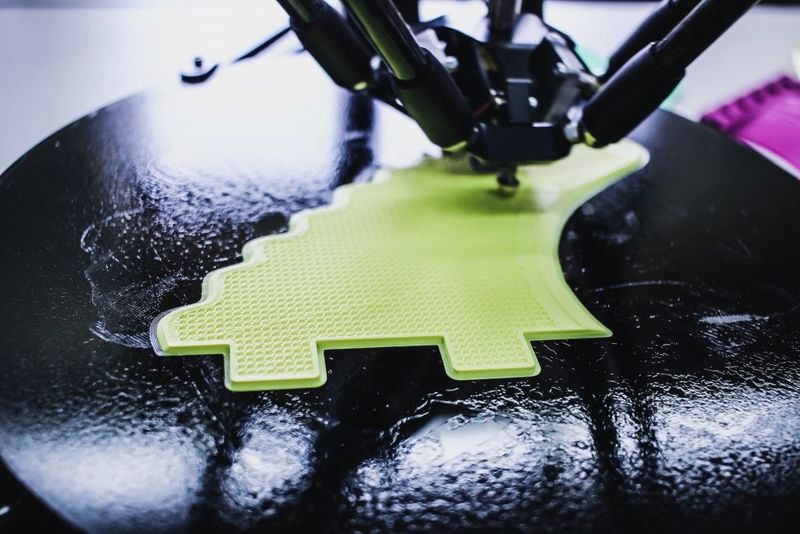
Traditionally, manufacturers use subtractive manufacturing, such as laser cutting: an object is formed by starting with a large piece of material and removing excess material in order to obtain its desired shape. Additive manufacturing, or 3D printing, uses digital designs to create three-dimensional objects, with the object created from the bottom up, by adding successive layers of material until the object takes shape.
Many companies stay nimble by utilizing both processes simultaneously and at different stages of the manufacturing process. However, 3D printing has 3 key advantages over subtractive manufacturing:
- Speed. 3D printing significantly reduces time between design and production. A 3D printer can quickly create a functional prototype for designers and engineers to test, which saves time and money that would otherwise be spent waiting on prototypes created using more traditional manufacturing processes.
- Less Waste. Subtractive manufacturing wastes a significant amount of material in the form of scrap pieces and shavings that are removed to shape the object. Even if these scrap pieces can be recycled, there is an added expense in time and money to see it through. In additive manufacturing, only the material that is needed to create the object is used.
- Design Complexity. 3D printers can produce an object with designs so complex and intricate that it would be impossible to produce using any other manufacturing method.
The revolution of Industry 4.0 is happening now, and 3D printing is driving it. Massive 3D printers are already “printing” homes—forming exterior and interior walls by piping in a special concrete mixture—for communities with inadequate housing such as impoverished or rural communities at risk. In the future, a patient suffering from organ failure may not need to wait on a donor transplant list in order to acquire a new, healthy organ—a doctor may be able to simply “print” a new organ for the patient. Through novel applications like these, 3D printing is helping to democratize the design and manufacturing process, changing what was once out of reach into a process that is accessible and affordable.
 Click here for more information.
Why Invest in 3D printing?
3D printing has been around since the 1980s, but it is only in the past decade that the technology has really taken off. Recent advancements in material science and design software have propelled the technology into the mainstream, and an increasing number of innovative companies are adopting the technology to optimize supply chains and address complex problems, from automotive, industrial equipment, and construction to medicine and healthcare, aerospace, and semiconductors.
In 3D printing, there is a lot of potential—and a lot of hype. Investors who invest for their long-term goals weigh the possible growth against risk. And they track several growing trends, from materials and data to personalization, software, and sustainability (2):
- Next-gen materials. Lighter, more robust, more reliable, more resistant to heat—the demand for innovative 3D printed materials is booming, from industries like automotive, aerospace, and medical research and regenerative medicine, where recent innovations in biological materials offer a glimpse of new horizons for medical care.
- Big Data. Success in today’s world means being smart about manufacturing. The interconnectivity of 3D printing makes analyzing data and connecting processes more efficient, allowing businesses to learn quickly and pivot to more streamlined processes of production.
- Personalization, on-demand. When sneaker designers brought superfans and 3D printing capabilities together, the result was a win-win. Brands that forge a personal connection to fans with the capabilities of 3D printing could be a guide for other industries.
- Software. Software that connects the dots in 3D printing from design and development through production and post-production helps create resilient manufacturing ecosystems, yet another way to foster growth in the industry as a whole.
- Sustainability. On-demand production forges resilient links in the global supply chain, with less need for warehousing. When parts are redesigned efficiently to be stronger, lighter, or to use less material, this also puts 3D printing into the sustainable space in a way that makes economic sense.
Once upon a time, 3D printing was sci-fi. As 3D printing comes of age—as it gets more advanced and cost-effective, and as pioneering novel applications transform industries—investors look behind the hype to find exciting trends, growth, and potential.
How to invest in 3D printing
3D printing is a relatively new industrial sector, and so investing directly in the companies that are leading the way can be risky. Many investors prefer investing in a mutual fund or ETF dedicated to 3D printing (3). This can be a good way to gain exposure to this fast-growing niche without taking on the risk of a direct investment.
According to a search on Magnifi, there are a number of ways to find the funds and ETFs that both access 3D printing and match your risk tolerance and interests:
- Invest in 3D printing
- Invest in 3D printing including healthcare
- Invest in 3D printing with low risk
References
- “3D printing trend report 2022,” accessed December 20, 2022, HUBS: A protolab company, https://www.hubs.com/get/trends/.
- Petch, Michael, “2022 Trends In 3D Printing, Forecasts From Additive Manufacturing Experts,” January 17, 2022, 3DPrintingIndustry.com, https://3dprintingindustry.com/news/2022-trends-in-3d-printing-forecasts-from-additive-manufacturing-experts-and-leaders-202426/.
- Mutual Funds and Exchange Traded Funds (ETF’s) are sold by prospectus. Please consider the investment objectives, risks, charges, and expenses carefully before investing. The prospectus, which contains this and other information about the investment company, can be obtained from the Fund Company or your financial professional. Be sure to read the prospectus carefully before deciding whether to invest.