How Much Do Americans Invest Today? More Than They Have in the Last Decade

How Much Do Americans Invest Today? More Than They Have in the Last Decade
This year, a near record 61% of Americans say they own stock of some sort, whether individually or through a tax-advantaged retirement account like a 401(k).
But what does the typical American's investment behavior look like across different assets, and why are more people investing in the stock market in recent years despite its swings?
Magnifi, the AI investing app, analyzed data from Gallup and the Federal Reserve to illustrate how Americans invest their income across various assets today.
Scientists at Gallup and data scientists at the Federal Reserve have been tracking these behaviors through surveys and financial data points over the last several decades. And those experts have found a correlation between income, education, age, relationships, and race that help us better understand how the typical American invests their money.
The COVID-19 pandemic flipped societies around the globe upside down. Yet, the pandemic era may also have served as a cap on a more than decade-long economic recovery that helped shift American investing habits.
In 2021 cryptocurrency was the word on everyone's lips.* NFTs were sold as the future of alternative asset investing and protecting intellectual property online through blockchain technology. Americans had extra cash in their pockets in the form of thousands of dollars in government stimulus. And homes were selling like hotcakes to a generation that came of age during the worst housing collapse in modern U.S. history. Millennials made up the largest generation of buyers at 43% of all home purchases [1] in 2021.
By 2022, however, the markets took a turn for the worse, erasing many of the gains made in previous years as inflation wore down companies and consumers alike. Higher interest rates set by the Federal Reserve to curb inflation made housing unaffordable to many, besides the wealthiest baby boomers.[2]
A study Bankrate performed last year found that just 18% of Americans [3] planned to invest more money into the stock market in the face of the volatility.
However, in the lead-up to last year's market correction, Americans were investing like they haven't in at least 15 years. Any fears still lingering from the one-two punch of a weakened stock market and falling real estate values after the 2008 financial crisis were fading. A recent Magnifi study confirmed this same finding with 63% of investors indicating they planned on investing more in 2023 than in 2022.
After decades of watching older generations build nest eggs through retirement accounts and rental property portfolios, investors showed the most interest in real estate and stocks.

Magnifi
Financial crisis impact lingers in American investment portfolios
In 2008, the stock market cratered. The country's 500 largest publicly traded companies [4] saw half of their values erased from 2007-2009. The number of Americans invested in the stock market fell from 63% in 2004 to 52% in 2013.
After the devastating blow that was the financial crisis of the aughts, the overall U.S. economy picked up speed in the latter half of the 2010s after Congress approved bailouts for ailing banks and auto manufacturers. Motor-vehicle sales rebounded as Americans snapped up SUVs, the energy sector asserted its shale-infused dominance and the tech sector blossomed, led by the global powerhouses we know today as Meta and Alphabet. And, with it, the typical American's income rose, albeit modestly.
With inflation taken into account, the rebound saw purchasing power gains of around 15% for the typical American working full-time compared to 1998. That's compared to the wealthiest 1% of Americans [5], who saw their purchasing power roughly triple in that same period.
Coinciding with that increase in income, Americans have started investing at rates more on par with 2008—a turning point when much of the public was losing faith in the stock market. A decade after the Great Recession decimated confidence in equity markets, Americans were sitting at home, avoiding getting sick and putting their money to work through commission-free retail trading apps.
Contrary to all of the uncertainty, near-zero interest rates set by regulators at the onset of the pandemic stimulated investment activity almost across the board. The pandemic-induced demand for tech products like video conferencing and delivery services, alongside the country's robust pharmaceutical industry working on vaccines, kept the stock market generating solid returns.
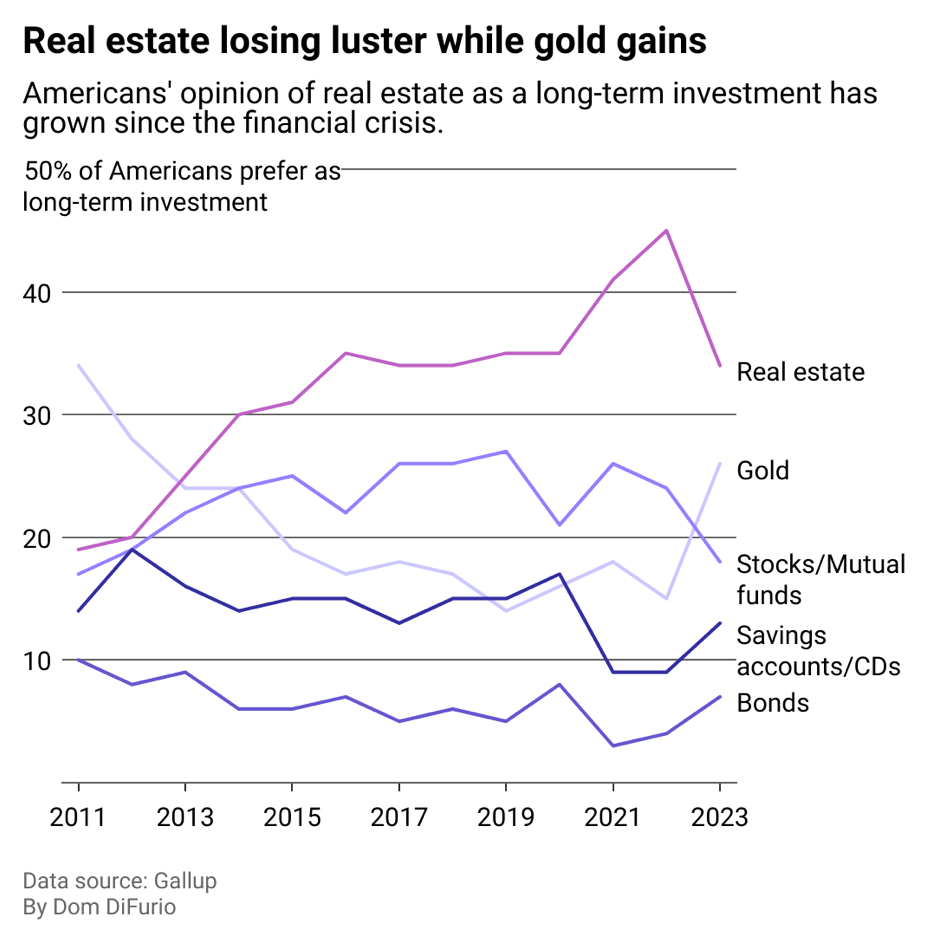
But the stock market is not Americans' preferred investment. That title belongs to real estate—an asset Americans view as the clearest route to financial freedom since it surpassed the stock market as the long-term investment of choice in 2013.
THE WORLD’S FIRST AI INVESTING ASSISTANT
Explore the AI investing assistant designed to help you find, plan, and buy investments for your unique financial goals.
Magnifi
Fewer Americans interested in stocks, CDs long-term as real estate slips
Gallup data also shows Americans' belief in real estate returns is fading. That could be due to the unaffordability of all types of housing nationwide since the Federal Reserve began raising interest rates [6] and inventory hit historic lows. The reported revenue drought hitting short-term rental platforms like Airbnb could further deteriorate confidence in real estate.
Bonds and certificates of deposit, or CDs for short, are some of the least-loved investments by Americans. Bonds are debts that can be purchased by anyone willing to part with their money for a while, expecting they will earn interest on the cash they lent out. Companies often issue bonds, but so does the U.S. Treasury. CDs involve placing your money in a bank for them to use to cover investments while you earn interest.
It's rare for Americans to hold these types of investments in high regard despite decades of financial advice on diversification.** It's also rare that Americans even engage in these investments, according to the Federal Reserve's Survey of Consumer Finances. Just 7.7% of U.S. families held CDs [7] in 2019, and 1.1% owned bonds.[8]
TOP-TIER INVESTMENT GUIDANCE & RESOURCES
Access a comprehensive investment blog including tips and resources to help you grow your wealth and invest with confidence.

Standret // Shutterstock
Americans who invest in stock are most likely to be white, college-educated, over 30, and female
Stock investors tend to belong to a class of white, non-Hispanic, college-degree-carrying millennials or older Americans. Today, women represent 62% of American investors [9] who say they are invested in the stock market through direct stock holdings, ETFs, or mutual funds, compared to 59% of men.
A 2019 Federal Reserve survey [10] found that while more than half of white and other households held equities such as stocks and mutual funds, less than 34% of Black households and less than 24% of Hispanic American households did the same. Black and Hispanic American families are notably risk-averse when it comes to investing, and this gap persists across education levels. Black Americans are more likely to invest in considerably safer assets [11], such as real estate, according to the Social Security Administration.
According to Gallup, 84% of Americans making $100,000 per year or more say they're invested as opposed to 63% of Americans earning $40,000-$99,000, and just 29% of those earning less than $40,000.
Story editing by Ashleigh Graf. Copy editing by Kristen Wegrzyn.
PERSONALIZED AI PLATFORM FOR INVESTING
Discover a personalized AI investing experience that leverages AI to help you achieve your financial goals.
References:
- Forbes
- NAR
- Bankrate
- Atlanta Fed
- Business Insider
- Forbes
- Federal Reserve
- Federal Reserve
- Gallup
- Federal Reserve
- Social Security Administration
Disclosures: *Cryptocurrency is a digital representation of value that functions as a medium of exchange, a unit of account, or a store of value, but it does not have legal tender status. Cryptocurrencies are sometimes exchanged for U.S. dollars or other currencies around the world, but they are not generally backed or supported by any government or central bank. Their value is completely derived by market forces of supply and demand, and they are more volatile than traditional currencies. Cryptocurrencies are not covered by either FDIC or SIPC insurance. Legislative and regulatory changes or actions at the state, federal, or international level may adversely affect the use, transfer, exchange, and value of cryptocurrency.
Purchasing cryptocurrencies comes with a number of risks, including volatile market price swings or flash crashes, market manipulation, and cybersecurity risks. In addition, cryptocurrency markets and exchanges are not regulated with the same controls or customer protections available in equity, option, futures, or foreign exchange investing.
Diversification does not guarantee a profit or protect against a loss in a declining market. It is a method used to help manage investment risk.
*Mutual Funds and Exchange Traded Funds (ETF’s) are sold by prospectus. Please consider the investment objectives, risks, charges, and expenses carefully before investing. The prospectus, which contains this and other information about the investment company, can be obtained from the Fund Company or your financial professional. Be sure to read the prospectus carefully before deciding whether to invest.