AI for all? Some Americans want digital assistant help more than others

AI has reached the tipping point for American investors
Five years ago, only 1 in 4 Americans admitted they trusted AI—and no wonder. Few forget the eerie HAL of 2001: A Space Odyssey or the relentless Terminator. And just as we’ve gotten used to chatbots, the killer doll M3GAN shows up to reignite our AI fears.
Today’s AI impacts our lives with far less drama, and perhaps that’s why so many people feel positive about it. In a recent survey by the AI-assisted investing platform Magnifi, 6 out of 10 (60%) Americans view artificial intelligence positively. They’re excited to discover how AI will make their lives easier and better (24%) or they see its potential to improve their lives (36%).
The same survey found that many Americans (46%) are gearing up to invest more in 2023 than 2022—signaling that investors are ready to put their money in the markets, despite the unpredictable economy. Also, just as AI is trending, 4 out of 10 Americans reported they would use guidance from sophisticated AI to invest. So all that buzz about Chat GPT? It may have tipped the balance.
Wealth management experts are taking notice of AI. As a conversational investing assistant, AI can not just analyze huge amounts of data—it puts that pro-level market intelligence into investors’ hands at a fraction of a financial pro’s fees. And crucially for the diversity of American experience across regions, ethnicity, and generations, AI’s ability to learn from experience means that investors can get guidance that’s tailored to their individual goals and needs.

But while more Americans are open to AI’s potential, there are significant gaps that need to be addressed for even more to reach their level of financial well-being.
Ready or not: Americans’ attitudes about AI
“Scientists Increasingly Can’t Explain How AI Works,” as one headline states. So when a majority of Americans report that they understand how artificial intelligence works, this percentage (66%) could arguably indicate the average American’s understanding of how Netflix, TikTok, and Google apply AI’s algorithms. Yet it’s significant that 2/3 of Americans are familiar enough with AI to feel confident explaining it.
Why? Familiarity breeds comfort not contempt, which is especially important for investors who need to feel comfortable with whomever—or whatever—they entrust with their personal finances. As the results of the recent survey by Magnifi show, AI has something for everyone…or almost everyone. And just when AI is transforming how people invest, who is ready—or not—for AI could have far-reaching impact.
Across the US, those who feel positive about AI are a diverse group
Most Americans have integrated AI into their lives no matter where they live or their background. From the West Coast to the East Coast, from the heartland of the Midwest to the South, 2 out of 3 Americans are comfortable with artificial intelligence. In fact, that same number also feel excited about its ability to make their lives easier or better, or see that AI has potential to improve their lives.
The majority of Americans who are most familiar with AI come from a variety of backgrounds. For example, 66 percent of those of Hispanic/Latino origin state they understand AI, matching the percentage of Caucasians who also say they do. The numbers tick higher for people identifying as African American or Black (68%), and those who identify as Asian or Asian American (70%).
Feeling positive about AI follows that pattern as well. Fifty-nine percent of people of Hispanic/Latino origin as well as 59 percent of Caucasians view AI as making their lives easier or better, or see its potential to improve their lives. Familiarity with AI increases to 68 percent of people identifying as African American or Black and then takes another jump to 78 percent of people who identified as Asian or Asian American.
With such a diversity of experiences, it’s no wonder that only 1 percent of investors choose robo-advisors for investing, whereas an AI-powered investing assistant can help people prioritize their individual goals—and meet them.
Rich and poor—a majority of Americans are familiar with AI
Whether they can afford to splurge on the latest high-tech AI gadget or are living paycheck to paycheck, most Americans say they know how AI works. People making more than $150,000 per year feel they understood AI the most (82%)—and they are also most excited about it (44%). Notably, as yearly income dropped, so did people’s stated familiarity with AI, from 66 percent of Americans making $60,000–$74,999 per year to 59 percent of Americans making less than $20,000.
Nevertheless, that’s still a high level of comfort with AI in general. Clearly, artificial intelligence isn’t just for tech billionaires anymore—and it can help new investors get started on big plans with even small budgets.
Love it or hate it, AI attitudes are divided by a generation gap
Call them snowflakes, slackers, or out-of-touch Boomers—the generations are divided, with younger Americans much more familiar with artificial intelligence and its applications. More than 3/4 of Millennials (77%) believe they understand AI followed by about 70 percent of both Gen Xers and Gen Zers. However, only 1/2 of Baby Boomers feel the same way.
There’s also a generational divide when it comes to how Americans feel about artificial intelligence. While 4 in 10 Millennials are excited about what AI can do to make their lives easier and better, only 1 out of 10 Baby Boomers feels the same way. Gen Xers and Gen Zers aren’t as excited about AI as Millennials, but a large number of them do recognize the potential of AI to improve their lives (44% of Gen Zers and 36% of Gen Xers).
The younger generations are in or entering their peak earning years. With AI-assisted investing, they can prioritize their personal risk tolerance and goals—and with AI guidance reallocate funds whenever life changes. They can feel more confident about navigating the markets, into the future.
However, men and women just don’t see AI eye to eye
The survey brought up a startling divide between American men and women, one that is especially troubling. Women’s disconnect with AI can put them at a disadvantage in investing—a stepping-stone to greater financial stability—when their earning power is already less than their male counterparts.
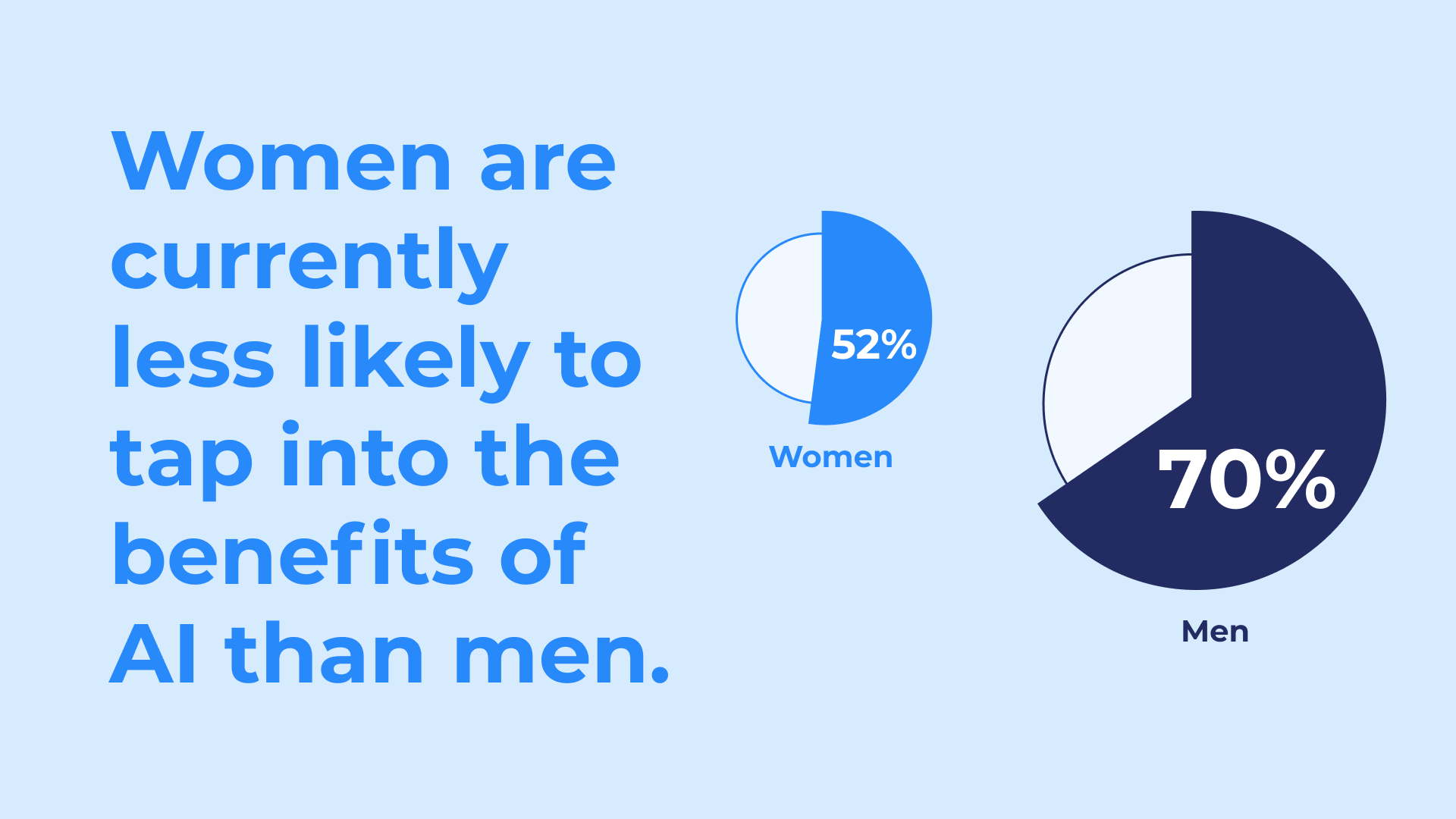
Nearly twice as many women say they do not understand artificial intelligence as men (41% of women compared to 26% men). Only half of women (52%) feel excited about how artificial intelligence will improve their lives or see its potential, compared to 70 percent of men. When asked about whether they would invest with guidance from sophisticated AI like Chat GPT, half of women (52%) stated they would not, while only 1/3 of men (33%) declined.
For every upswing in positive sentiment toward AI, it’s important to acknowledge those who may be left behind, especially when so much is at stake. Women bear a disproportionate share of caregiving, which keeps them out of the workforce. Even if they are employed, women bring home less than men do, at all stages of their careers. An AI-powered investing assistant can help women make their financial plans achievable in less time, with fewer fees—and more confidence.
It’s exciting that so many are recognizing AI’s powerful potential. But for all of AI’s capabilities that financial professionals can leverage, the real game changer is what AI can do for the average investor. Those who are ready for AI stand to benefit from its wealth-growing potential—now and in the future.
Are you ready to try the power of AI in your personal investing?
On Magnifi, you can start your investing journey with a simple search. Look for the companies you love, the causes that matter, and how you can achieve your financial goals. With Magnifi Personal, you can put all this in action and, with a personal investing assistant, set up your plan—from buying a house to retirement.
References:
- “Share of people who agree they trust artificial intelligence in 2018, by country,” Statistica, accessed February 2, 2023, https://www.statista.com/statistics/948531/trust-artificial-intelligence-country/.
- Mack, Justin L., “ChatGPT: Miracle, meme or menace?,” February 14, 2023, Financial Planning, https://www.financial-planning.com/news/chatgpts-role-in-wealth-management.
- Xiang, Chloe, “Scientists Increasingly Can’t Explain How AI Works,” November 1, 2022, Motherboard, vice.com, https://www.vice.com/en/article/y3pezm/scientists-increasingly-cant-explain-how-ai-works.
- Evans, Julie Ryan, “63% of Americans — Led by Millennials — Open to Using a Robo-Advisor,” October 3, 2022, Magnify Money by Lending Tree, https://www.magnifymoney.com/news/robo-advisor-survey.
- Rebalancing/Reallocating can entail transaction costs and tax consequences that should be considered when determining a rebalancing/reallocation strategy.
- Pino, Ivana, “Over 20% of Americans say they’d need to earn $1 million each year to feel rich—here are a few tips to boost your income,” December 13, 2022, Fortune Recommends, https://fortune.com/recommends/article/over-20-percent-of-americans-say-theyd-need-to-earn-1-million-each-year-to-feel-rich/.
- “Fact Sheet: The State of Women in the Labor Market in 2023,” February 6, 2023, American Progress.org, https://www.americanprogress.org/article/fact-sheet-the-state-of-women-in-the-labor-market-in-2023/.